 EN


Airport Safety Barrier Solutions for Baggage Handling and Ground Operations
Airport safety barriers are most useful when they are planned around the way people, baggage equipment, and aircraft-service vehicles actually move. On a busy ramp or in a baggage makeup area, a tug may pull carts through the same broad zone where agents cross to scanners, belt loaders, doors, or staging positions. The objective is not to turn every open space into a fence. It is to make the highest-exposure conflicts easier to see, harder to enter by mistake, and less likely to interrupt the operation.
As an EHS coordinator, start with the route before the product. A barrier is only one part of a control system that also includes local rules, markings, visibility, training, supervision, and access management. The FAA's ground-vehicle guidance specifically addresses vehicles such as tugs, baggage carts, and fuel trucks; that is a useful reminder that airport traffic has different approach paths and stopping conditions than a typical warehouse.
Why airport baggage areas need a different barrier plan
Well-placed airport safety barriers can turn an informal mixed-traffic area into a clearer operating zone without treating the barrier as a substitute for safe driving or local ramp rules.
Baggage handling and ground operations are dynamic. Flight schedules change, equipment queues form, weather affects surfaces, and temporary baggage or supplies can narrow a lane without warning. OSHA's baggage-handling guidance recognizes that the work has multiple hazards, so a sound layout does not rely on one control alone. Airport safety barriers should support a site-specific route plan rather than substitute for operational discipline.
Three questions usually reveal where separation is needed:
- Where do people regularly cross or work beside moving tugs, tractors, belt loaders, dollies, or forklifts?
- Where can equipment turn, reverse, or queue with limited sightlines?
- Which doors, emergency paths, aircraft-service points, and maintenance areas must stay accessible?
Map those answers by shift, not just during a quiet walkthrough. A crossing that looks adequate at midday may become a pinch point during banked departures or irregular operations.
Define the zones before choosing airport safety barriers
When evaluating airport safety barriers, define the intended boundary, the people it protects, the vehicle movement it influences, and the access it must leave open.
Baggage makeup and sortation edges
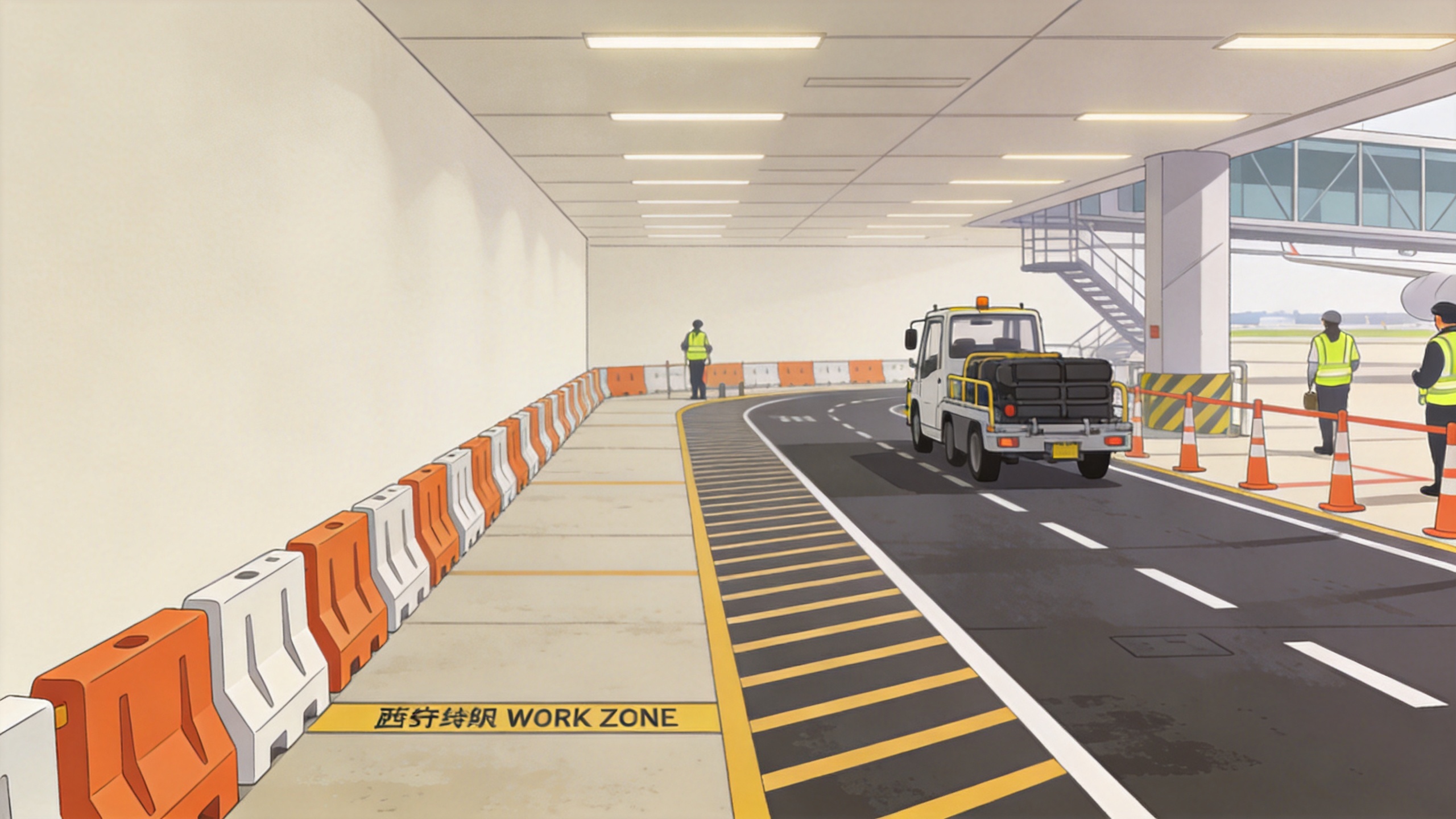
At the boundary between conveyor work and vehicle movement, a low, highly visible physical separation can help distinguish the pedestrian work envelope from the tug or cart route. Leave deliberate openings only where handlers need to transfer bags, service equipment, or evacuate. The opening itself needs a clear operating rule; an unprotected gap can quickly become the preferred shortcut.
Tug, cart, and ground-support-equipment lanes
Airport safety barriers at lane edges work more reliably when their alignment is based on observed cart-train paths, not a theoretical straight line.
Use route geometry, turning movement, queue length, and visibility to decide whether the lane needs continuous protection, targeted end protection, or simply better markings and controlled crossings. Industrial safety barriers can be useful at corners, work-cell edges, and the ends of protected runs, but their placement should not reduce the maneuvering clearance that drivers need to make a safe turn.
Gate-adjacent pedestrian crossings
At these locations, airport safety barriers can guide approach behavior and discourage unplanned entry into the vehicle envelope.
Crossings deserve a deliberate design: a visible approach, a protected waiting area where appropriate, an unambiguous path, and no stored equipment that hides a person from a driver. The goal is to guide movement predictably. A physical barrier may channel a crossing, while signage, local procedures, and ramp awareness determine when it is safe to use.
Match the barrier approach to the exposure
Airport safety barriers should be selected after the exposure is described, because a gate-side crossing, a baggage sortation edge, and a cargo-support route do not impose the same demands.
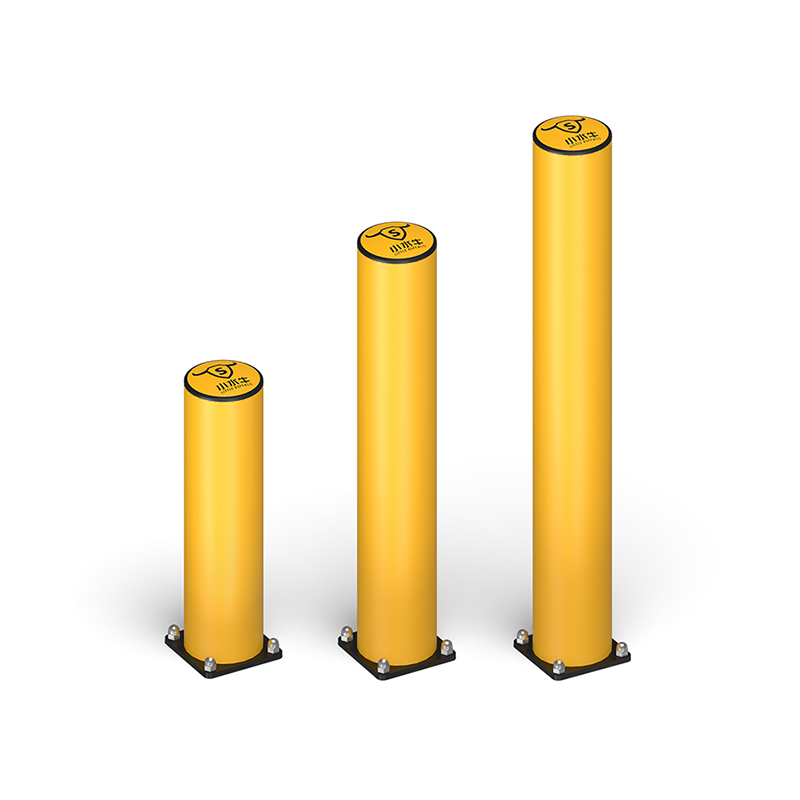
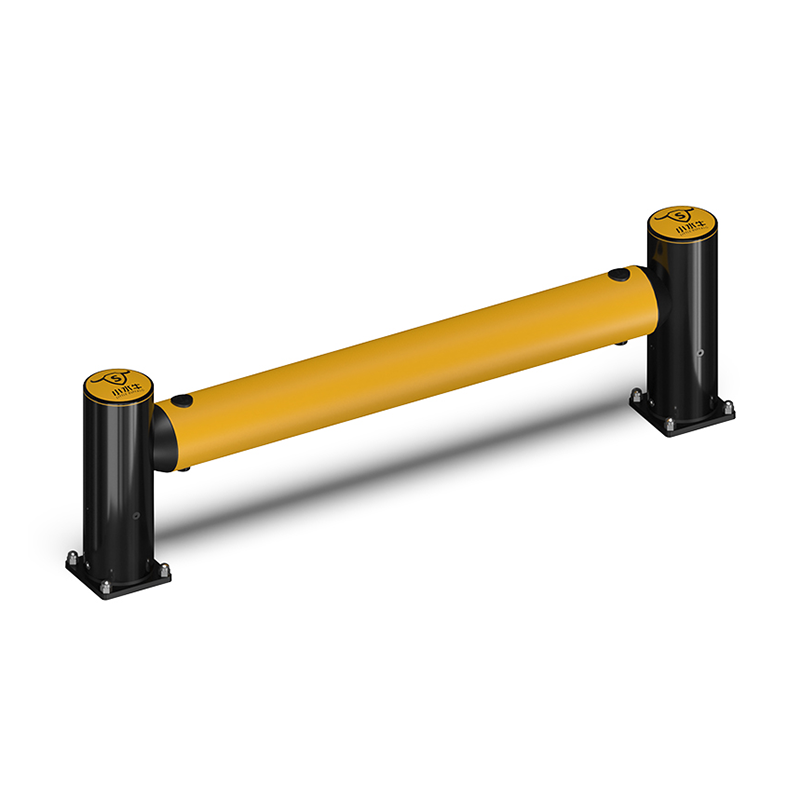
There is no universal barrier type for airport operations. A practical comparison starts with the exposure, the mounting surface, and the operational consequence of a contact event. Rigid steel systems, flexible polymer systems, bollards, guard rails, and modular guard fencing each have different fit conditions. Ask suppliers for evidence that applies to the proposed configuration and expected impact direction rather than assuming a generic product claim covers every airport use.
| Airport location | Primary concern | Planning focus |
|---|---|---|
| Conveyor or makeup edge | People working beside moving equipment | Separate work space while preserving bag-flow and service access |
| Tug or cart route corner | Late visibility and turning movement | Protect the corner, maintain sweep clearance, improve sightlines |
| Doorway or access point | Vehicle contact near an opening | Protect the asset without blocking emergency or maintenance access |
| Pedestrian crossing | Unplanned route entry | Channel walking paths and reinforce crossing rules |
Forklift collision protection is relevant where forklifts support baggage, cargo, stores, or maintenance activity. Treat forklift routes as their own exposure scenario. Travel speed, load height, reversing frequency, blind corners, and floor condition all influence whether a barrier layout is appropriate and how much clearance it needs.
Specify with operations, not from a catalog
For airport safety barriers, specification should record both the operational condition and the physical installation condition so a proposed layout can be reviewed against the real task.
A useful request-for-quotation package includes a scaled route sketch, photos of corners and doorways, vehicle types, approximate traffic peaks, mounting conditions, required access openings, and known near-miss locations. Involve ramp operations, facilities, maintenance, baggage leadership, and EHS early. Each group sees a different failure mode: an operations lead may flag a queue pattern, maintenance may identify a service panel, and EHS may recognize an informal pedestrian shortcut.
For any candidate system, verify the manufacturer documentation for the specific model, height, anchors, substrate, expected vehicle, and impact direction. Do not equate a material description, a catalog image, or an unrelated test statement with suitability for a particular airport ramp condition.
Install in phases and check the real workflow
A phased trial of airport safety barriers gives ramp teams an opportunity to confirm that the protected route remains usable when activity is highest.
Before a broad rollout, trial the most exposed route or a representative gate area. Mark the proposed line, run normal equipment through the space, and observe it during a busy period. Look for cart-train tracking, door swings, baggage overflow, line-of-sight changes, and places where people bypass the intended path. This operations-first check often improves a layout more than adding another segment of barrier.
After installation, inspect for loosened fixings, damage, encroachment, blocked access, and changed traffic patterns. Review the layout after equipment changes, construction, seasonal schedule shifts, or recurring near misses. Airport safety barriers remain effective only when the route they support still matches the operation around them.
A practical airport barrier checklist
Use this checklist to turn the airport safety barriers discussion into a documented, cross-functional site review.
- Identify vehicle and pedestrian paths by shift and peak workload.
- Prioritize blind corners, crossings, queue areas, and workstations beside moving equipment.
- Confirm aircraft-service, emergency, cleaning, and maintenance access before finalizing lines.
- Choose industrial safety barriers by actual exposure, mounting conditions, and verified documentation.
- Include forklift collision protection where cargo or support-facility traffic creates a distinct risk.
- Pair physical separation with markings, procedures, training, and routine inspections.
Little Buffalo Technology can support an application-led discussion about flexible protection concepts for industrial traffic zones. Share a route sketch, site photos, equipment information, and the access conditions that cannot be compromised so the conversation can focus on a configuration appropriate to the operating environment.
Frequently asked questions
These answers address recurring questions about airport safety barriers in baggage and ground-support environments.
Can airport safety barriers replace ramp procedures?
No. They are a physical control that can reinforce route separation, but airport operations still require local procedures, driver awareness, markings, training, and supervision.
Where should a baggage operation start?
Start with route mapping during active shifts. Focus first on recurrent pedestrian-vehicle conflicts, blind corners, crossings, and places where baggage or equipment changes the usable width of a lane.
What should be verified before installing a barrier?
Confirm vehicle types, turning paths, mounting conditions, required access, and product documentation for the proposed configuration. A site-specific review is essential before treating any solution as suitable.
 Hot News

