EN


Stainless Steel Safety Barriers for Hygienic and Corrosive Environments
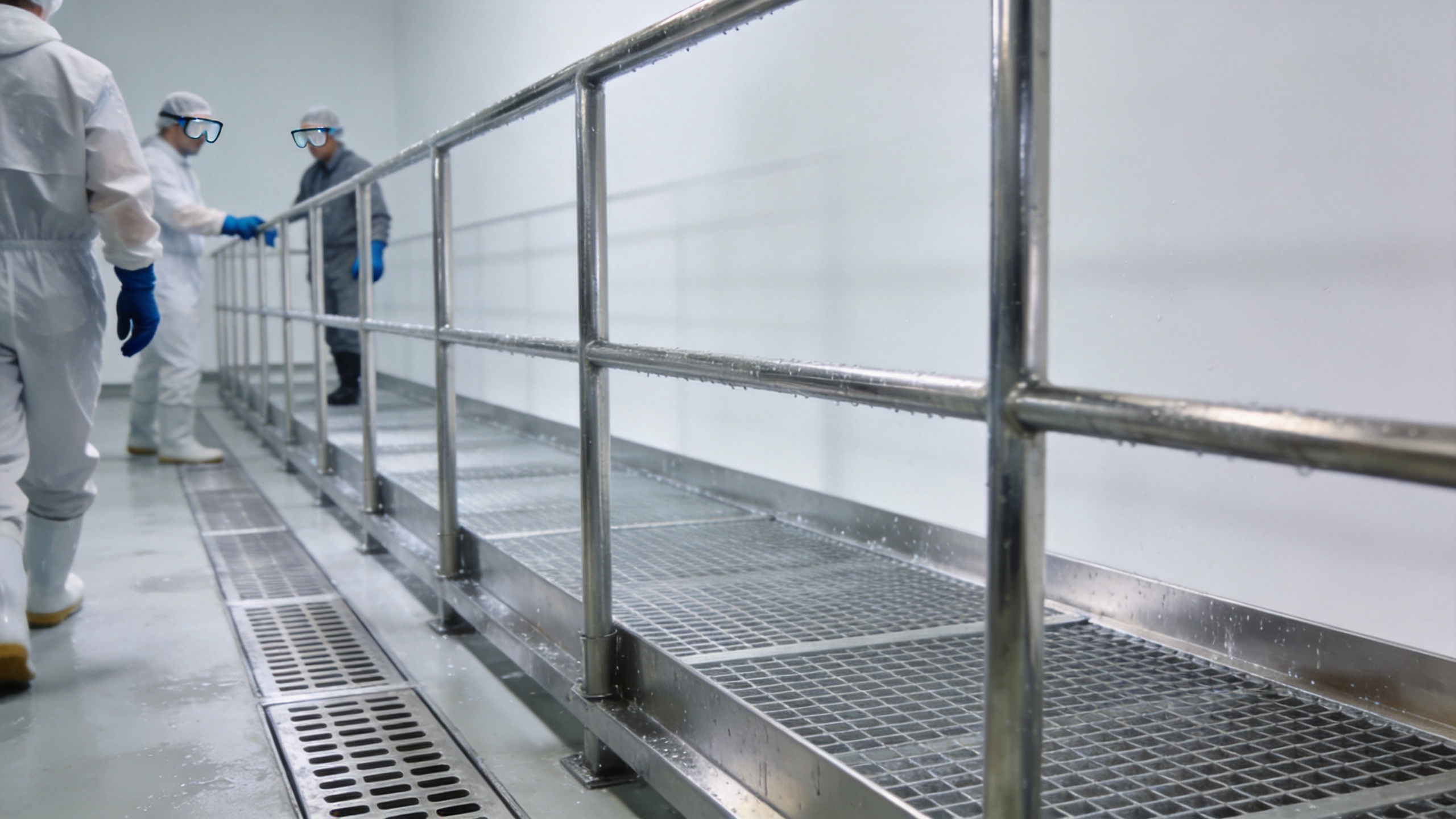
In a washdown room, a food-processing aisle, or a chemical handling area, a barrier is not simply a line between people and traffic. It becomes part of the cleanability, inspection, and maintenance plan. That is why stainless steel safety barriers should be selected from the operating environment outward—not from a catalog image inward. A maintenance planner should first map what reaches the barrier: wheels, pallets, splashes, foam, rinse water, cleaning chemicals, and people moving through the zone.
The useful question is not merely whether stainless steel looks clean. It is whether a particular barrier geometry, grade, finish, fixing method, and cleaning routine will remain fit for the actual exposure. This guide addresses selection questions; it does not replace a site-specific safety, chemical-compatibility, or engineering review.
Why hygienic and corrosive areas need a different barrier brief
Stainless steel safety barriers are often considered where painted surfaces can chip, where frequent cleaning makes rough surfaces difficult to manage, or where a durable visual boundary is needed. Those are sensible starting points, but they are not a complete specification. In hygienic spaces, trapped liquid, exposed threads, open tube ends, and inaccessible floor interfaces can complicate cleaning. In corrosive spaces, the challenge may be chloride-containing cleaners, process residues, temperature, dwell time, poor rinsing, or deposits that remain on the surface.
Cleaning guidance from public-health sources makes the wider point: material compatibility includes the ways chemicals can contribute to corrosion, distortion, or other damage. Some chlorine or hypochlorite-based products can be corrosive to metals. That does not mean every use rule is the same; it means the cleaning regime must be checked before selecting stainless steel safety barriers. Obtain the actual chemical name, concentration, temperature, contact time, rinse practice, and frequency. Then ask the material supplier or qualified reviewer to confirm compatibility for the intended service.
Start with the hazard and the cleaning route
A neat-looking layout is useful, yet the likely impact path and the cleaning route should be checked before appearance drives the decision. For stainless steel safety barriers, document four things on a simple zone drawing:
- Impact exposure: vehicle type, turning paths, load overhang, reversing areas, and likely contact points.
- People flow: where operators walk, wait, cross, clean, or access valves and panels.
- Washdown flow: where liquid lands, drains, pools, or is difficult to rinse away.
- Maintenance access: inspection reach, removable panels, floor repair, and access behind the barrier.
For chemical plant safety barriers, route separation remains central. OSHA materials discussing hazard controls identify pedestrian aisles, barriers, and crossings as methods for keeping people away from fork trucks. The lesson is practical: a barrier is one control within a coordinated system of routes, markings, sightlines, speed management, and procedures. Stainless steel safety barriers cannot make an unsafe traffic plan safe on their own.
Specify details that support cleaning
In a hygienic setting, a barrier profile can matter as much as the base material. Look for surfaces that can be reached, wiped, rinsed, and inspected. Avoid specifying stainless steel safety barriers with unnecessary horizontal ledges, unsealed cavities, sharp dirt-catching transitions, or fixing details that leave residue-prone gaps. Put simply, a cleanable boundary needs more than a corrosion-resistant label.
Discuss whether tube ends are closed, how joints are finished, whether anchors are accessible for inspection, and how the floor connection behaves under washdown. If a barrier must be close to a wall or process line, leave enough clearance for cleaning tools and visual checks. This is often the point where access constraints become clearer. A configuration that blocks the cleaner’s path can create a maintenance problem even if it provides the desired separation.
Choose material and finish against the real exposure
Not all stainless steels perform the same way in every environment. Rather than treating a grade designation as a guarantee, make exposure verification part of the purchase decision. For stainless steel safety barriers, provide the specification team with the chemical list, any salt or chloride exposure, temperatures, cleaning schedule, drainage condition, and expected impact duty. Ask what material, finish, weld treatment, and fastener combination are appropriate for those documented conditions.
Pay particular attention to interfaces. A well-chosen rail can still be undermined by incompatible fasteners, damaged coating on adjacent items, crevices at a base plate, or standing liquid at the floor. Chemical plant safety barriers may also face airborne process contaminants or intermittent spills, so the normal operating condition and the credible upset condition should be considered separately. That may be a workable configuration, although the mounting context and emergency-cleaning procedure still need review.
Mounting is part of barrier performance
A barrier’s effectiveness depends on the whole installed assembly. Before finalizing stainless steel safety barriers, assess the substrate, slab condition, reinforcement constraints, edge distances, anchor type, load path, and clearance for cleaning. Do not assume a heavier-looking rail is automatically a better answer. Additional material does not by itself improve protection if the fixing arrangement, approach angle, or site geometry has not been evaluated.
For a process aisle, consider whether the barrier should protect people, control trolley movement, protect pipework, or define a no-entry zone. Each purpose can lead to a different height, spacing, gate arrangement, or termination detail. The aim is not to make every area look enclosed; it is to make high-exposure interactions easier to control.
Plan inspection and maintenance before installation
Long-term value from stainless steel safety barriers depends on an inspection routine that fits the facility. Include the barriers in regular walk-throughs and check for loosened anchors, deformation, cracked seals, damaged weld areas, surface deposits, drainage problems, and changes in traffic patterns. After an impact or chemical spill, inspect the affected section rather than assuming a polished surface proves continued fitness.
A practical record can include location, barrier purpose, exposure notes, cleaning method, inspection date, observed damage, and action owner. Revisit the layout after process changes, new vehicles, altered chemical programs, or revised pedestrian routes. If the route changes by shift, review traffic during more than one operating period before changing the layout.
A short buying checklist
- Define what the barrier must separate or protect.
- Map vehicle paths, pedestrian crossings, washdown reach, and drainage.
- Share the exact chemical and cleaning conditions with qualified material reviewers.
- Review cleanability of joints, bases, fasteners, tube ends, and nearby clearances.
- Confirm mounting design and substrate conditions for the intended impact exposure.
- Set inspection, cleaning, and post-impact review responsibilities before handover.
Stainless steel safety barriers can be a practical part of a hygienic or corrosive-area control plan when they are specified around verified exposure and real site movement. Use this as a starting framework, then confirm dimensions, material compatibility, mounting, and application evidence before specification.
 Hot News