EN


How to Compare Flexible Safety Barrier Performance, Durability, and Cost
When a forklift turns close to a packing line or a pedestrian route, the barrier decision is not simply a choice between a soft-looking rail and a rigid-looking one. Flexible safety barrier performance should be compared against the route, the likely impact direction, the people and assets exposed, and the work that must continue around the installation. A barrier can be part of a stronger separation plan, but it does not replace traffic rules, markings, training, or a site-specific risk review.
From a warehouse buyer’s perspective, the practical comparison begins with disruption: what could an impact damage, how would that damage affect operations, and what would it take to restore the area? This guide offers a repeatable way to assess flexible safety barrier performance, durability, and cost without treating any single rating or material as automatically suitable for every site.
Start with the operating conditions, not the catalogue
A common planning miss is comparing only a headline impact claim. That can hide meaningful differences in test conditions, mounting arrangements, impact angle, vehicle type, and protected geometry. Before comparing polymer safety barriers or steel systems, document the operating conditions that the proposed barrier must address:
- Vehicle type, approximate travel path, turning behavior, and traffic periods.
- Whether pedestrians, doors, racks, machinery, or workstations sit behind the proposed line of protection.
- Available clearance, visibility, escape paths, cleaning requirements, and maintenance access.
- Floor condition, mounting constraints, drainage, temperature, and likely future layout changes.
HSE guidance on workplace transport emphasizes separating pedestrians and vehicles where possible, with adequate clearance and visibility. That context matters because a barrier is one control within a wider route-management plan. Put simply, a product comparison follows the route problem rather than the other way around.
What “performance” should mean in a barrier comparison
For flexible safety barrier performance, ask how the system behaves under a defined event rather than asking which barrier has the biggest advertised number. A useful review separates four questions.
1. Is the evidence applicable?
Request the test method, stated impact conditions, installed configuration, and the part of the system being evaluated. PAS 13:2017 is a workplace-barrier code of practice that addresses impact resilience, dimensions, positioning, and test methods. It can help a buyer frame questions, but a reference to a standard is not by itself proof that a particular configuration is suitable for a particular site. Confirm what evidence applies to the actual barrier height, post spacing, fixing method, substrate, and intended traffic exposure.
2. What moves during impact?
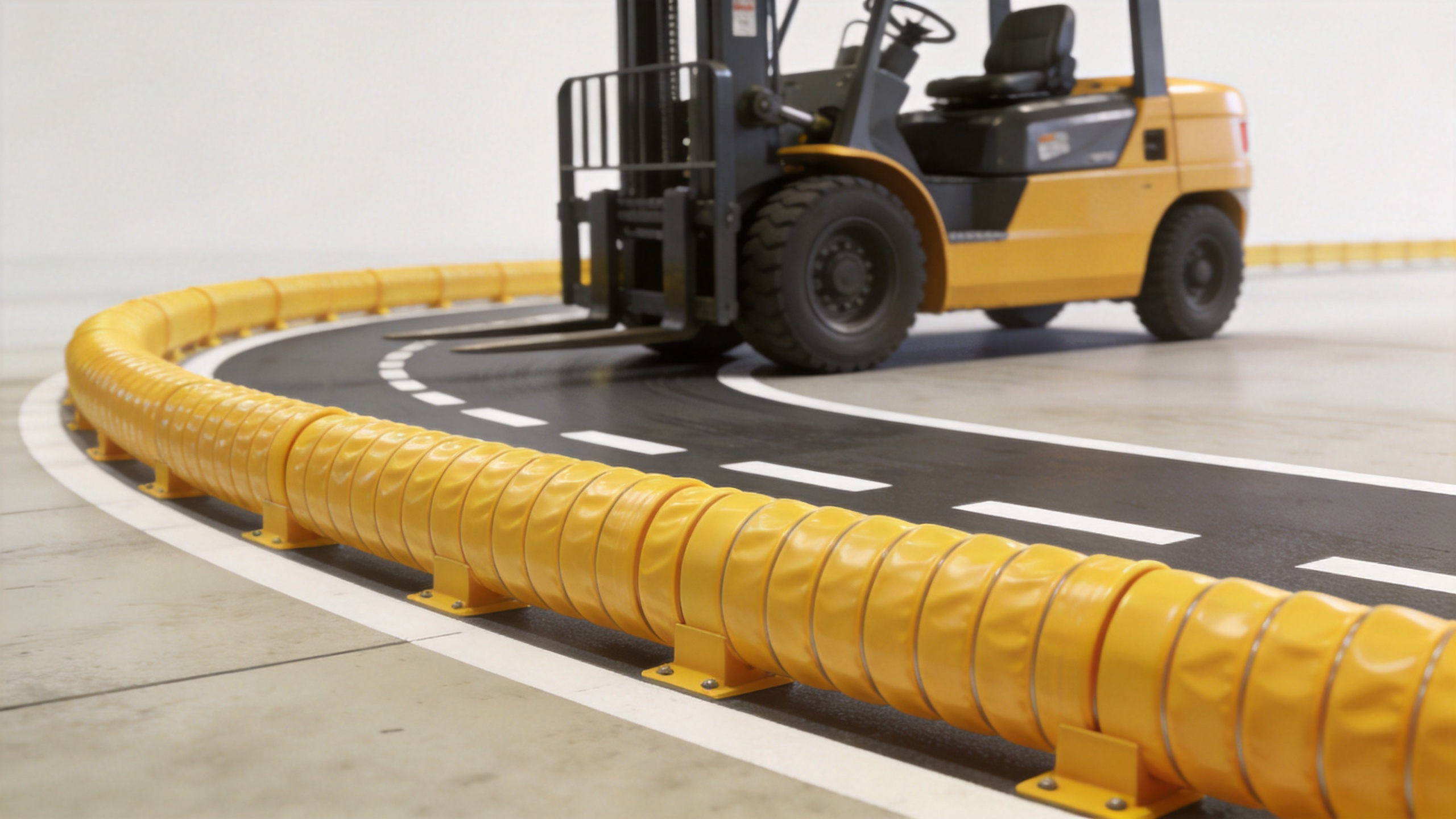
Flexible crash barriers are often evaluated for their ability to deflect, absorb, or distribute energy through their design. The key question is not whether movement occurs; it is whether the available movement fits the protected zone. A system that deflects may need clear space behind it. Conversely, a rigid system may have different consequences for the barrier, floor anchors, vehicle, or protected asset. Compare the complete load path, not just the rail material.
3. What remains protected after the event?
Ask what the supplier’s evidence says about rail retention, anchor condition, protected clearance, and required inspection after an impact. Flexible safety barrier performance should be judged alongside the site’s acceptable recovery procedure: can the area remain isolated, who inspects it, and what conditions require replacement or reconfiguration?
4. How does the barrier support route understanding?
A clearly visible boundary still has to make sense to the people using a shared route. Check sight lines at crossings, gate locations, corners, and places where pallets temporarily narrow the space. The aim is not to enclose every area; it is to make high-exposure interactions easier to recognize and control.
Compare durability as an operating requirement
Durability is more useful than a broad “long-lasting” claim when it is broken into inspection and recovery questions. For polymer safety barriers, evaluate the supplier’s documented guidance on exposure, cleaning, connections, replacement parts, and inspection criteria. For every option, consider:
- Routine condition: What should operators or maintenance teams inspect, and how often?
- Impact recovery: Which components may be reset, repaired, or replaced after a reported strike?
- Interface durability: Are posts, fixings, gates, and transitions reviewed as a system rather than as separate purchases?
- Environment: Will washdown, chemicals, temperature variation, UV exposure, or traffic debris affect the documented maintenance plan?
- Change readiness: If a production line or aisle changes, can the barrier layout be reviewed and adapted without creating new blind spots or access conflicts?
A maintenance-focused comparison often reveals costs that a purchase-price table misses. It is easy to assume that a service door will remain usable after installation; verify it against normal tasks, cleaning, emergency access, and peak traffic periods.
Use lifecycle cost, not just initial price
Initial quotation cost matters, but it is only one part of the comparison. Build a lifecycle worksheet for each proposed configuration. Include survey and design time, installation and temporary traffic control, inspection, expected repair or replacement processes, spare-part availability, and the operational impact of taking an area out of service.
| Cost category | Questions to compare |
|---|---|
| Planning and design | Has the proposal accounted for traffic patterns, clearances, substrate, and interfaces with gates or equipment? |
| Installation | What access, shutdown, drilling, lifting, and route controls are needed during installation? |
| Inspection and upkeep | Who checks the system, what evidence is recorded, and what triggers corrective action? |
| Impact response | What is the documented process for isolating, assessing, repairing, or replacing affected parts? |
| Operational disruption | How would a repair affect production, loading, pedestrian access, or vehicle flow? |
| Future modification | What must be reviewed if racks, machinery, doors, or traffic routes move? |
More detail can improve a procurement decision, but only after the site inputs are reliable. Avoid converting possible downtime avoidance into a savings figure unless the facility has documented its own incident and recovery data.
A practical scoring method for flexible safety barrier performance
Use the same evidence-based questions for every option. Score each category only after reviewing the relevant documents and site conditions:
- Application fit: vehicle path, impact direction, barrier geometry, and protected zone.
- Evidence fit: test conditions, configuration, and installation assumptions relevant to the application.
- Separation contribution: visibility, clearance, interfaces, and how the barrier works with markings and procedures.
- Recovery plan: inspection, isolation, repair, replacement, and return-to-service decisions.
- Lifecycle practicality: installation disruption, cleaning, access, maintenance labor, and future changes.
This approach makes flexible safety barrier performance a decision about verified applicability, not a contest of isolated marketing claims. It also gives procurement, operations, EHS, and maintenance teams a shared set of questions before an RFQ is finalized.
Questions to ask before selecting polymer safety barriers
- Which vehicle movements and impact directions are realistically expected at this location?
- What test evidence and installation conditions support the proposed configuration?
- How much deflection space is available without reducing safe clearance?
- What happens after an impact, and who is authorized to decide whether the barrier remains in service?
- How do flexible crash barriers fit with route markings, pedestrian controls, gates, and training?
- What will change if equipment, rack lines, or traffic volumes change next year?
Make the final comparison site-specific
The most useful comparison is transparent about its limits. Polymer safety barriers may be a suitable option where their documented behavior, maintenance plan, and configuration fit the exposure, but the decision still requires verification of the actual route and installation. Record assumptions about vehicle type, traffic direction, and mounting context so later reviewers can test whether they remain true.
Use this framework as a starting point, then confirm dimensions, impact evidence, and operating requirements before specification. A deliberate review of flexible safety barrier performance, durability, and lifecycle cost can support a clearer, more defensible barrier decision.
 Hot News