EN


Polymer Safety Barrier Materials: Properties, Benefits, and Limitations
In a busy warehouse, production area, or loading zone, the useful question is rarely “Which barrier looks strongest?” It is “What route, impact exposure, and operating practice must this control support?” Polymer safety barrier materials are increasingly considered where teams need visible separation between people, vehicles, racking, doors, or equipment. Their value comes from the way a properly designed system can manage certain impacts while fitting a working environment. They are not a substitute for traffic rules, operator training, route design, or a site-specific risk assessment.
From an industrial safety engineering perspective, the decision begins with the likely impact path: vehicle type, travel direction, speed, turning radius, frequency, and the people or assets on the other side of the boundary. OSHA guidance says forklift traffic should be separated from workers and pedestrians where possible, with permanent railings or other protective barriers among the controls to consider. That context matters because a barrier supports separation; it does not create zero risk.
What are polymer safety barrier materials?
Polymer safety barrier materials are engineered plastics or composite polymer systems used in protective rails, bollards, post-and-rail systems, corner protection, and route-separation equipment. Depending on the formulation and design, a polymer barrier may flex, deflect, deform in a controlled way, or distribute a load through posts, rails, couplings, and anchors. The material alone does not determine performance. Geometry, reinforcement, mounting, substrate condition, impact direction, and the complete system design all affect what a barrier can reasonably do.
In practice, buyers often compare polymer safety barriers with steel guardrails or steel bollards. That is a useful comparison only when the operating conditions are made explicit. A rigid steel system may be appropriate for one hazard and a flexible system may be appropriate for another; neither label is a complete design brief. Before treating an impact claim as a decision point, confirm what test evidence applies to the proposed installation, including the vehicle, impact angle, anchor arrangement, and site conditions.
Properties that influence barrier behavior
Flexibility and energy management
A key reason facilities investigate polymer safety barrier materials is that some designs are intended to flex under impact and recover to a usable position when the event stays within their tested design envelope. Put simply, the barrier choice follows the route problem rather than the other way around. Controlled movement can be useful when a system is designed to reduce abrupt load transfer, but a product photograph or general statement alone does not establish that a polymer barrier will be flexible in the required way. Ask how the full assembly behaves, what movement space is required, and what evidence supports that behavior.
Corrosion resistance and surface condition
Many polymer-based systems are selected for environments where moisture, routine washdown, or corrosive conditions make surface maintenance a planning issue. A polymer exterior may avoid some of the paint damage and corrosion concerns associated with exposed metal surfaces. However, the complete installation still needs inspection: fasteners, anchors, foundations, interfaces with doors, and any mixed-material components can remain relevant. Resistance to one environmental condition does not prove suitability for every temperature, chemical, ultraviolet, or hygiene requirement.
Visibility, modularity, and workflow fit
Color contrast and a clearly defined physical boundary can help workers recognize intended routes, especially near crossings, doorways, and rack ends. Modular polymer safety barriers can also make it practical to plan straight runs, corners, gates, or zone changes around the layout. That may be a workable configuration, although the mounting context still needs review. A common planning miss is checking forklift turning clearance only after the proposed barrier location is fixed. Check clearances during normal shifts, including pallet overhang, reversing maneuvers, cleaning access, and emergency egress.
Benefits in the right application
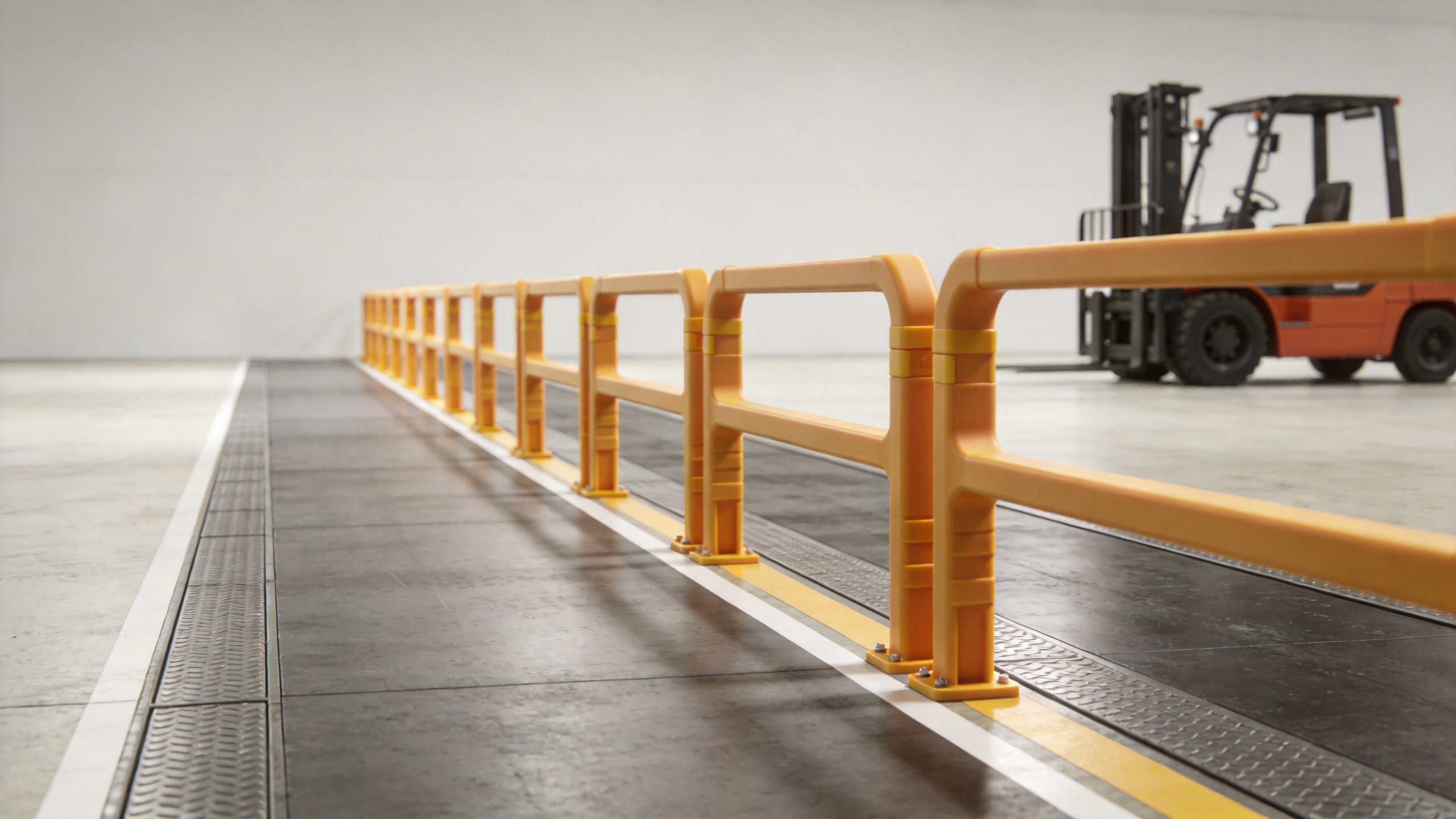
When selected and installed for a verified use case, polymer safety barrier materials can support a layered approach to risk reduction. HSE guidance identifies protective barriers, clear route markings, and raised kerbs as ways to separate vehicle and pedestrian areas. This reinforces an important point: the barrier should work with markings, signage, lighting, crossing rules, and training rather than be treated as the only control.
- Route definition: A physical boundary can reinforce where pedestrians should walk and where industrial vehicles should travel.
- Adaptability: Modular layouts may help teams revise a protected area when equipment, storage, or access needs change.
- Potentially simpler post-impact recovery: For a system designed to flex within its limits, some lower-severity contacts may require a different inspection and recovery process than a damaged rigid rail. The actual maintenance response must follow the supplier’s documented instructions.
- Operational clarity: Clearly placed flexible crash barriers can help make a vehicle–pedestrian interface easier to see, but the layout must still preserve sightlines and safe crossings.
These are application-dependent benefits, not guarantees. A neat-looking layout is useful, yet the likely impact path should be checked before appearance drives the decision.
Limitations and questions buyers should not skip
The limitations of polymer safety barrier materials are as important as their benefits. They have finite performance envelopes. A system that is appropriate for a low-speed forklift route may not be appropriate for a heavier vehicle, a higher travel speed, an oblique strike, a high-energy reversing zone, or a location where the substrate cannot support the intended anchors. Clearance for deflection can also be a constraint: a barrier that moves during impact needs enough space so that its movement does not create a new exposure behind it.
Temperature, chemicals, ultraviolet exposure, repeated impacts, local fire requirements, hygiene requirements, and cleaning methods can all change the suitability question. So can changes to traffic patterns. If the route changes by shift, review traffic at more than one operating period before choosing a layout. Also distinguish between a product’s stated performance and the performance of a complete installed system. Site-specific engineering, supplier documentation, and applicable local requirements should be reviewed before specification.
How to compare polymer and rigid barrier approaches
Rather than asking which category is universally better, compare polymer safety barrier materials and rigid protection using the same criteria:
- Hazard: What vehicle, object, or movement creates the exposure?
- Protected target: Are you separating pedestrians, protecting a doorway, shielding racking, or controlling a crossing?
- Impact conditions: What speed, direction, height, frequency, and vehicle mass are relevant?
- Installation context: What substrate, anchor method, drainage, clearance, and access constraints apply?
- Evidence: Which test reports, installation instructions, inspection requirements, and limitations apply to the proposed configuration?
- Operational change: How will the area be reviewed if equipment, shifts, storage, or routes change?
Can a pedestrian still understand the intended route when pallets temporarily occupy the area? Can a driver see the crossing from the approach direction? These questions often reveal whether a barrier plan is supporting operations or merely adding hardware.
A practical selection checklist
Before purchasing polymer safety barrier materials, map the site rather than beginning with a catalog. Mark vehicle paths, pedestrian routes, junctions, blind corners, doors, emergency exits, charging areas, and maintenance access. Record the operating periods that create the highest interaction. Then request configuration-specific documentation from a qualified supplier and verify how the proposed system aligns with your site’s risk assessment and local requirements.
For many facilities, a coordinated plan is a practical outcome: separate routes where possible, clear crossings where routes must meet, suitable barriers where exposure remains, and routine inspection after changes or impacts. Polymer safety barriers may play a valuable role in that plan when their limitations are understood and their configuration is verified.
Conclusion
Polymer safety barrier materials offer useful design possibilities for industrial route separation, especially where visibility, modular layouts, and controlled system behavior are relevant. Their benefits depend on the complete system and the installation context, not on material type alone. Start with the route and hazard, verify the evidence for the proposed configuration, and treat barriers as one layer in a broader safety-management approach.
 Hot News