EN


What to Look for in a Flexible Safety Barrier Supplier
Choosing a flexible safety barrier supplier is not simply a catalog exercise. In a warehouse, production floor, or loading area, the useful starting point is the route problem: where vehicles travel, where people cross, what must remain accessible, and what evidence is needed before a configuration is specified. From a warehouse buyer’s perspective, a good flexible safety barrier supplier helps turn those practical questions into a clear scope rather than pushing a one-size-fits-all product.
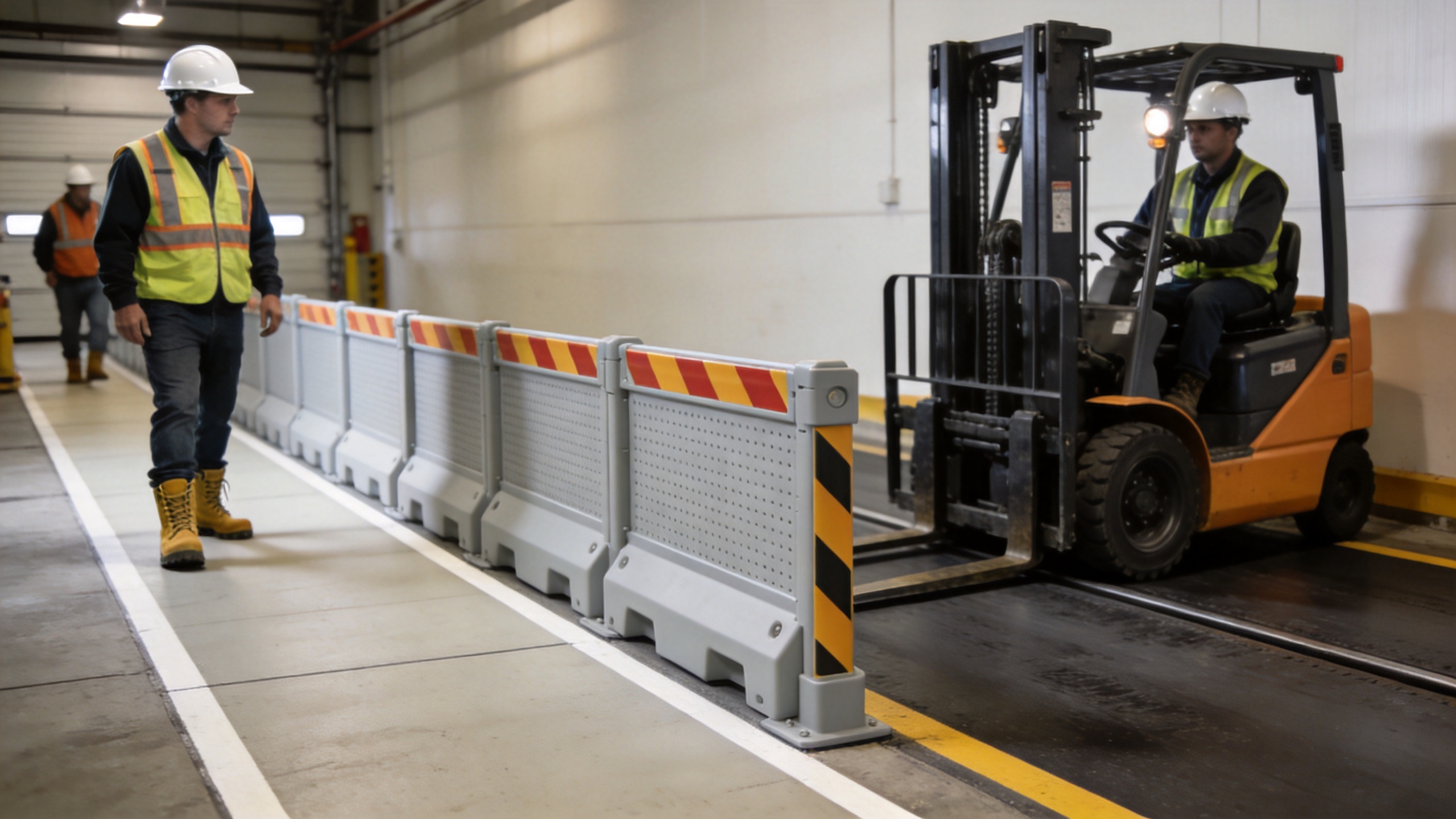
That distinction matters because a barrier is one part of a wider traffic-management plan. OSHA’s forklift pedestrian guidance says forklift traffic should be separated from pedestrians where possible and identifies walkways, permanent railings or other protective barriers, and floor striping as possible measures. A flexible safety barrier supplier should therefore be ready to discuss how physical separation works alongside markings, operating rules, training, and visibility—not as a replacement for them.
Start with the operating area, not the brochure
Before comparing designs, ask a flexible safety barrier supplier to understand the zone. Describe the vehicle types, likely approach directions, turning locations, pedestrian shortcuts, doors, service points, rack ends, and peak-period changes. The catalog can narrow options, but turning radius and service access usually determine the final fit. A capable industrial safety barrier supplier will ask for dimensions, sketches, photos, or a layout plan instead of assuming that one barrier height or post spacing fits every area.
In active facilities, the revealing places are often where forklifts and pedestrians converge. Observe the route across more than one operating period if shifts, dispatch windows, or temporary pallet storage change the way people move. Put simply, the barrier choice follows the route problem rather than the other way around. If a supplier does not ask about actual movement, access needs, and mounting context, the comparison may be incomplete.
Ask how the supplier matches evidence to the application
Claims about impact behavior deserve context. When evaluating a flexible safety barrier supplier, request the test documentation, the claimed standard or method, the configuration tested, and the conditions that determine whether the evidence applies to your installation. A stated rating alone does not design a layout. Before treating a performance statement as a decision point, confirm what evidence applies to the vehicle, approach, geometry, substrate, and intended use.
A credible flexible safety barrier manufacturer should be able to explain the boundary of its documentation without overstating it. Useful questions include: Was the exact product family tested? Which mounting arrangement was used? What vehicle type, impact direction, and site conditions are relevant? Is third-party verification available where claimed? The purpose is not to demand a universal answer; it is to compare evidence on equal terms. Any published claim should be accompanied by the relevant test, standard, or project evidence after verification.
Compare configuration support, not just individual components
A strong flexible safety barrier supplier can help a buying team think in zones. A forklift route next to a pedestrian walkway may call for a different discussion from a rack-end exposure, an entrance, or a guarded workstation. Rather than evaluating a single rail or bollard alone, map how it works with markings, gates, traffic rules, and the adjacent route. This system view is especially useful when several stakeholders need to agree on a procurement brief.
Ask the industrial safety barrier supplier how it handles transitions, corners, ends, gates, and interfaces with existing controls. Also ask which inputs could change the recommendation. A neat-looking layout is useful, yet the likely impact path should be checked before appearance drives the decision. A supplier that can document assumptions and explain alternatives helps the team distinguish a preliminary concept from a final site-specific design.
Check installation readiness and practical support
Installation is where a promising comparison can become a difficult project. A flexible safety barrier supplier should ask about floor construction, mounting surfaces, access for installers, working hours, clearance around equipment, and constraints on shutdowns. Do not treat the floor and substrate condition as a minor detail; it may affect what needs review. The relevant question is how the site condition affects the intended protective function.
For an international buyer, clear documentation also matters. Ask what drawings, installation instructions, fastening requirements, handover records, and site-review support are available. A responsive flexible safety barrier manufacturer should state what it can provide and what still needs confirmation locally. That may be a workable configuration, although the mounting context still needs review.
Evaluate lifecycle support before comparing price alone
The purchase price is only one input. When comparing a flexible safety barrier supplier, include inspection guidance, cleaning access, repair or replacement paths, spare-part availability, lead times, and the process for reviewing a layout after operational changes. Increasing protective coverage can affect service access, so review both on the same plan. A supplier that discusses these tradeoffs early is more useful than one that focuses only on an initial quote.
Ask what triggers a review after installation: a new rack line, a changed vehicle fleet, a revised pedestrian route, or recurring edge damage. Record assumptions about traffic direction and vehicle type so later reviewers can test whether they remain true. The goal is to reduce exposure in the route, not to imply zero risk.
Use a supplier-comparison checklist
- Does the flexible safety barrier supplier ask for route, traffic, access, and mounting data?
- Can the supplier explain the scope and applicability of evidence behind its claims?
- Does the proposal distinguish pedestrian protection, asset protection, and operational access?
- Are drawings, installation information, and responsibilities clear before work begins?
- Can the supplier explain inspection, replacement, and change-review options?
- Does the industrial safety barrier supplier avoid unsupported promises and identify what requires site verification?
Choose the partner that helps you verify the fit
A capable flexible safety barrier supplier is not necessarily the one with the longest feature list. It is the one that helps your team define the exposure, collect the right site inputs, compare evidence responsibly, and keep access and lifecycle needs visible. For a flexible safety barrier manufacturer, that means communicating what is documented, what is configurable, and what must be reviewed for the installation.
Use this framework as a starting point, then confirm dimensions, operating conditions, and applicable evidence before final specification. A well-prepared request gives every flexible safety barrier supplier a fairer basis for responding—and gives your team a more useful way to compare the answers.
 Hot News