EN


What Certifications Should Buyers Look for in Industrial Safety Barriers?
When reviewing industrial safety barrier certifications, buyers often begin with a simple request: “Show us the certificate.” That is reasonable, but it is not enough. A certificate can describe a management system, a product family, a test sample, or a particular installation condition. It does not automatically prove that a barrier suits every forklift route, rack end, doorway, or pedestrian crossing.
From an industrial-safety engineering perspective, industrial safety barrier certifications should be assessed alongside traffic routes, impact exposure, mounting conditions, and operating practices. The useful question is not merely whether a document exists. It is whether the document’s scope matches the barrier configuration and the risk you are trying to control.
This guide explains how to read industrial safety barrier certifications, request usable evidence from a flexible safety barrier manufacturer, and compare documentation from an industrial safety barrier supplier without turning a headline claim into an assumption.
Start with the difference between certification, testing, and compliance
The language around industrial safety barrier certifications can be confusing because several types of evidence are often grouped together. Ask a supplier to identify exactly which category each document belongs to.
- Management-system certification may show that a manufacturer operates a quality or environmental management system. It is not automatically a performance approval for a particular barrier.
- Product certification may apply to a defined product, construction, or declared scope. Check the issuer, certificate number, dates, model names, and exclusions.
- Test report records a test method, specimen, setup, loading direction, mounting arrangement, and result. For industrial safety barrier certifications, this can be more decision-useful than a broad certificate when the application is impact-sensitive.
- Declaration or conformity statement is a supplier statement. It may be useful, but buyers should ask what underlying evidence supports it.
Put simply, a document is only as useful as its applicability. Before treating an impact statement as a decision point, confirm what evidence applies to the intended installation.
Use the site risk assessment to decide what evidence matters
Not every facility needs the same evidence package. ISO 12100:2010 sets out terminology, principles, and a methodology for machinery-safety risk assessment; it is not a universal product certificate for standalone barriers. Still, its logic is useful when evaluating industrial safety barrier certifications: identify the hazard, assess exposure, choose controls, and document the basis for the decision.
For example, OSHA guidance on forklift pedestrian traffic says that forklift traffic should be separated from workers and pedestrians where possible. It lists pedestrian walkways and permanent railings or other protective barriers among possible controls. That guidance does not mean OSHA “certifies” a barrier. Instead, it helps a US facility define why separation is needed before it asks for evidence.
A practical review should record vehicle type, travel direction, approximate speed controls, turning locations, pedestrian behavior, visibility, floor condition, required access, and the protected asset or person. The suitable evidence for industrial safety barrier certifications depends on those conditions, not on a single headline feature.
Check whether the document scope matches the actual configuration
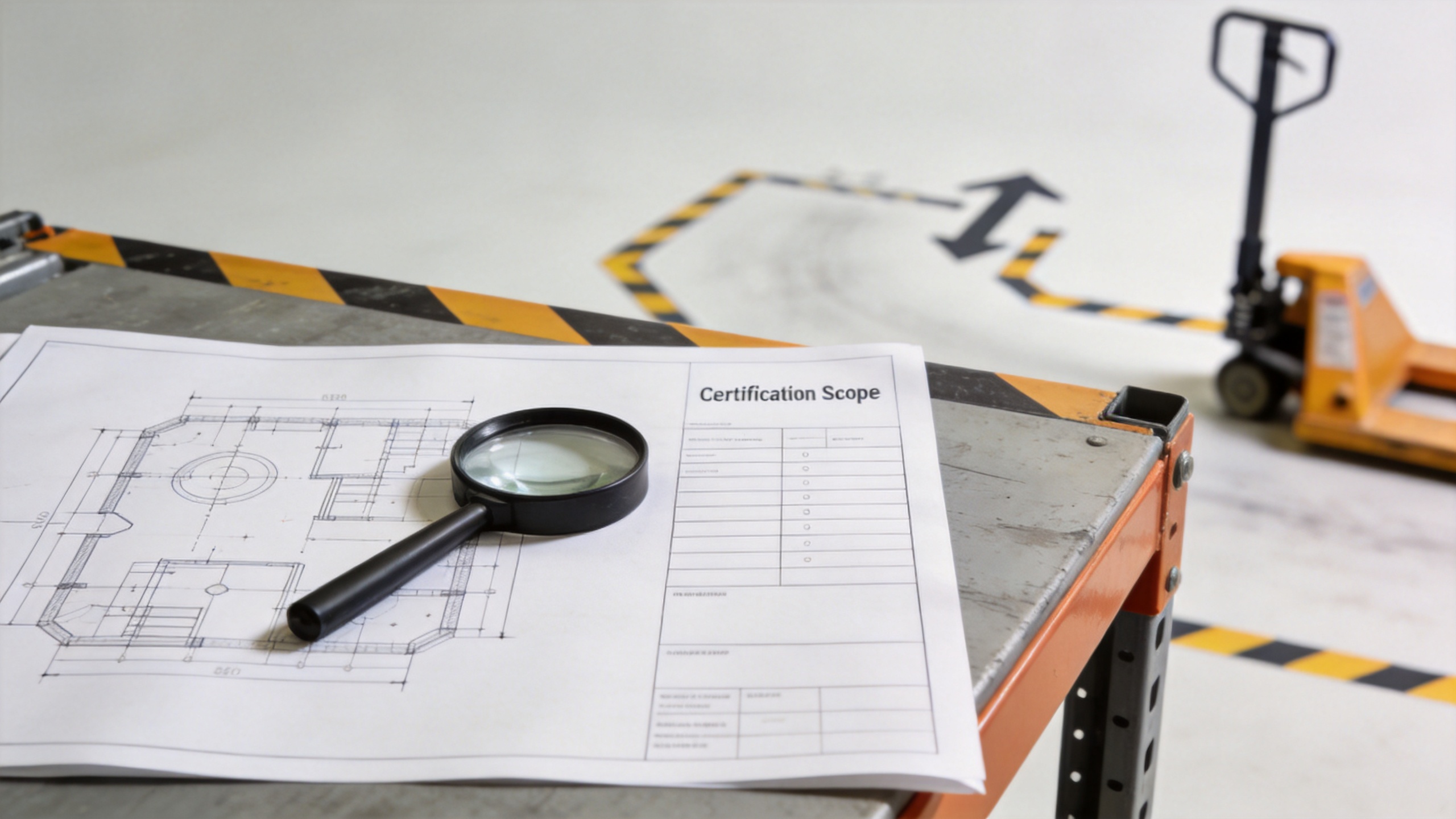
When comparing industrial safety barrier certifications, request the complete document rather than a cropped logo or marketing excerpt. Then compare these points against the proposed configuration:
- Product identity: Does the report name the same model, height, material, components, and accessories being quoted?
- Test method and laboratory: Who performed the work, what method was used, and is the laboratory or certification body identifiable?
- Test setup: What vehicle or impactor, direction, energy, speed, angle, and mounting arrangement were used?
- Pass criteria: What was measured, and what does the stated result actually mean? Do not infer a broader performance claim than the report makes.
- Installation conditions: Was the specimen fixed to a similar floor, substrate, anchoring system, and layout?
- Validity and traceability: Is the document current, version-controlled, and connected to the supplier and product being offered?
Comparing only a headline impact claim can hide important differences in application conditions. This is why industrial safety barrier certifications should be read with the test report, drawings, installation instructions, and any stated limitations.
Do not apply a rack or machinery standard outside its scope
Buyers may encounter familiar standards in warehouse discussions and assume they apply to every protective product. For instance, EN 15512 addresses structural design requirements for adjustable beam pallet-rack systems fabricated from steel members. It may be relevant to a racking context, but it is not automatically a certification for a floor-mounted pedestrian barrier, bollard, or polymer guardrail.
The same discipline applies to all industrial safety barrier certifications: ask what the standard covers, what product category it addresses, and whether the document applies to your proposed layout. A standard name on a brochure is not a substitute for scope review.
Questions to ask a flexible safety barrier manufacturer
A capable flexible safety barrier manufacturer should be able to help separate confirmed evidence from items that need site validation. Ask for a document pack that includes the exact product reference, drawings, installation instructions, relevant test or certification records, and the contact details for clarification.
- Which industrial safety barrier certifications apply to this exact configuration?
- What is the difference between the certificate, the test report, and the supplier’s own declaration?
- Which mounting substrate, anchors, and spacing were included in the evidence?
- Does the evidence cover the likely direction of vehicle approach and the protected height?
- What limitations, exclusions, inspections, or maintenance actions are stated?
- Can the issuer or laboratory be independently verified?
It is not just about creating a boundary; more precisely, it is about making the boundary work with the way the zone operates. If the route changes by shift or pallets temporarily narrow an aisle, review traffic at more than one operating period before final specification.
How to compare an industrial safety barrier supplier fairly
When several suppliers provide industrial safety barrier certifications, use one evidence matrix rather than comparing logos. Place each offered configuration in a row and use the same columns: model, document type, issuer, issue date, standard or method, tested configuration, mounting condition, stated limitation, installation requirement, and verification status.
An industrial safety barrier supplier that provides clear scope information may be easier to assess than one that makes a broad claim without supporting detail. That does not make any product universally suitable. It makes the procurement review more transparent and helps EHS, engineering, operations, and purchasing discuss the same facts.
A final buyer checklist for industrial safety barrier certifications
Before approving a purchase, confirm the risk assessment, barrier location, route dimensions, mounting conditions, access needs, and the evidence scope. Then verify that the product and installation described in the quotation align with the documents supplied. Where evidence is incomplete, record it as a review point rather than a conclusion.
The goal of industrial safety barrier certifications is not to create a paperwork-only decision. The goal is to give the team traceable evidence for a defined application while keeping barriers within a broader plan of traffic control, markings, training, inspection, and operational review. Use this framework as a starting point, then confirm current local requirements and application evidence before specification.

 Hot News