EN


Industrial Safety Barriers for Assembly Lines and Workstations
Assembly areas are built for movement: people deliver parts, operators reach into stations, carts circulate, and forklifts may supply material at the edge of the line. That movement is useful until routes overlap. Assembly line safety barriers help make the intended boundary visible and physical, but a sound layout starts with the work rather than a catalog.
From a facility-safety planning perspective, the first questions are where people walk, where vehicles turn, what can be struck, and what still needs to be reached during normal work, cleaning, maintenance, and changeovers. A barrier can support separation; it is not a substitute for machine guarding, training, traffic rules, or supervision.
Start With the Operating Zone, Not the Barrier Type
It is tempting to compare rail heights or materials first. A more useful starting point is a map of actual movement over more than one shift. Watch where a tugger reverses, where a forklift delivers pallets, where operators step out for replenishment, and where temporary containers narrow a route. These observations reveal conflict points that a drawing may miss.
For assembly line safety barriers, divide the area into practical zones:
- Pedestrian-only space: operator positions, walkways, inspection points, and emergency access.
- Vehicle space: forklift, pallet-jack, tugger, or cart travel lanes and turning envelopes.
- Equipment space: machine perimeters, robot cells, conveyors, utilities, and control cabinets.
- Transfer space: handoff points where materials cross from delivery routes to workstations.
The boundary should make the intended behavior easy to understand. If a worker must repeatedly open, step over, or route around it to do normal work, the design needs another look.
Separate Traffic Risks From Machine-Guarding Risks
Traffic separation and machine safeguarding solve different problems. OSHA guidance for powered industrial trucks advises separating forklift traffic from workers and pedestrians where possible, using measures such as walkways, permanent railings or other protective barriers, and floor striping where barriers cannot be used. That principle supports a layered design: paths, markings, visibility aids, operating rules, and physical separation should reinforce one another.
Machine hazards need their own controls. OSHA’s general machine-guarding requirements address risks such as points of operation, ingoing nip points, rotating parts, flying chips, and sparks. In other words, assembly line safety barriers around a cell may limit access or shield a route, but they do not prove that the machine itself is adequately guarded. Confirm the safeguarding requirements for each machine and task with qualified safety and engineering personnel.
Choose a Barrier Configuration by Exposure
The suitable configuration depends on the likely impact path, the vehicle type, available clearance, mounting conditions, and access needs—not on a single headline feature. Use the questions below before comparing options.
| Area | Planning question | Barrier role |
|---|---|---|
| Line-side pedestrian edge | Can a vehicle encroach on the operator route? | Define and protect the pedestrian boundary while preserving exits. |
| End of a conveyor or workstation bank | Is there a direct approach path from material handling traffic? | Help deflect or stop low-level contact before it reaches equipment. |
| Material presentation point | How will loads be delivered without crossing people? | Guide the transfer process and protect the exposed edge. |
| Crossing or intersection | Can sightlines be kept clear during busy periods? | Channel movement without hiding approaching traffic. |
For example, factory collision protection near a pallet-drop zone may call for a more robust vehicle-facing boundary than the rail that simply guides an operator walkway. The two locations may look similar on a plan, but their exposure is different.
Protect Access, Clearance, and Recovery Work
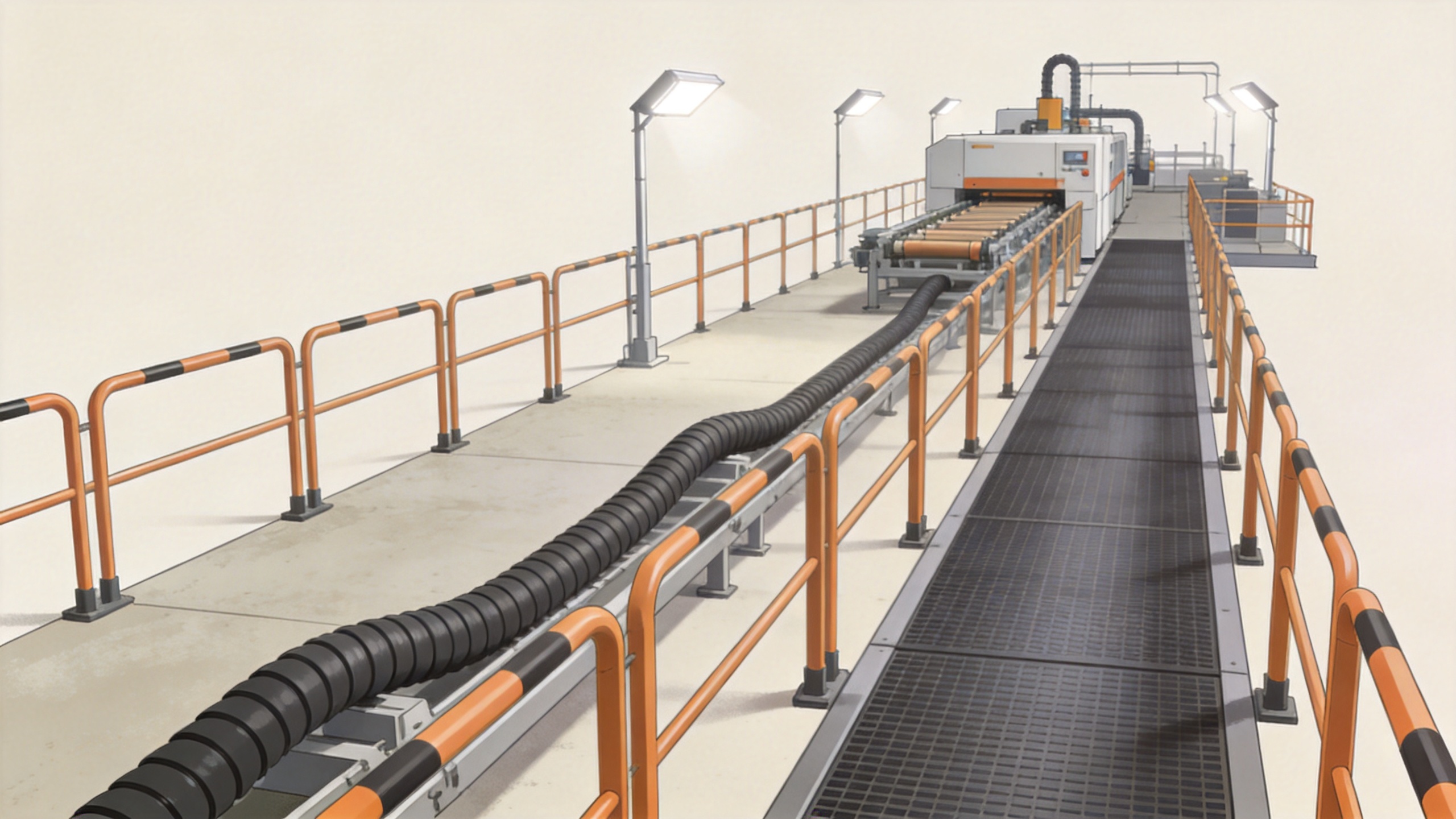
A neat perimeter can still create a poor operating area. Check the room needed for carts, hand trucks, pallet handling, egress, cleaning equipment, and maintenance access. Also consider what happens after an abnormal event: a jammed conveyor, a spilled container, or a stopped line. Workers need a safe, understood way to recover without improvising around the boundary.
This is where industrial guardrails should be reviewed as part of the whole zone. Ask whether gates, removable sections, or protected openings are needed; whether a gate can be used without creating a new vehicle-pedestrian conflict; and whether any barrier end is exposed to a likely strike. Do not assume a low-traffic route presents no risk. Shift changes, peak deliveries, and temporary obstructions can change the exposure quickly.
Plan Visibility and Information Together
Physical separation works more reliably when the route remains legible. Use markings, signs, designated crossings, mirrors or warning devices where appropriate, and clear housekeeping standards alongside assembly line safety barriers. OSHA also requires permanent aisles and passageways to be kept clear and appropriately marked where mechanical handling equipment is used. A barrier layout should therefore preserve the route rather than become an obstruction inside it.
Put simply, the barrier choice follows the route problem rather than the other way around. If a boundary is hard to see, blocks a key sightline, or encourages shortcuts, adjust the layout before treating more material as the answer.
A Practical Review Checklist Before Installation
- Document pedestrian, vehicle, and material movements during representative operating periods.
- Mark crossings, blind corners, reversing points, and places where operators leave workstations.
- Identify the equipment and assets that need protection from vehicle contact.
- Separate traffic controls from machine-guarding requirements and verify both independently.
- Check clearance, egress, maintenance access, sanitation, and changeover tasks.
- Confirm mounting conditions and obtain product-specific technical documentation for the exposure being addressed.
- Brief operators and material-handling teams, then review the layout after the process is live.
Build a Safer Boundary Around the Work
Well-planned assembly line safety barriers can help facilities make routes clearer, protect exposed equipment edges, and reduce opportunities for people and vehicles to occupy the same space. The most useful design is rarely the most elaborate one. It is the one that reflects real traffic, supports the work, preserves access, and is verified against the actual hazards in the zone.
Before committing to a configuration, walk the line with the people who operate, replenish, clean, and maintain it. Their practical observations can reveal the constraints that determine whether assembly line safety barriers remain a helpful control after the first week of production.
 Hot News