EN


How to Select Warehouse Safety Barriers Based on Traffic and Risk Levels
Warehouse safety barrier selection starts with the operating area, not a catalog image. From a facility-safety planning perspective, the useful question is where people, forklifts, powered pallet trucks, loads, racking, doors, and workstations can come into conflict. A barrier is one layer of control: it can help define separation and protect exposed assets, but it does not replace route design, rules, training, visibility measures, or vehicle-operation discipline.
We often focus first on rail height or material. The more useful first question is where forklifts and pedestrians actually cross paths. That shift helps a warehouse team select warehouse safety barriers according to the traffic and risk they must manage rather than according to appearance alone.
Start with a traffic-and-risk map
Before comparing barrier types, map each traffic zone over a normal shift and a busy period. Mark vehicle routes, pedestrian routes, crossings, reversing areas, doors, rack ends, battery-charging areas, packing stations, and places where temporary pallets reduce usable width. If traffic changes by shift, review more than one operating period before choosing a layout.
A practical map also records what changes the consequence of contact: vehicle type, travel direction, turning behavior, load height, sightlines, surface condition, proximity to people, and the asset or process behind the proposed barrier. This is warehouse collision prevention in its useful form: identifying exposure before choosing a physical product.
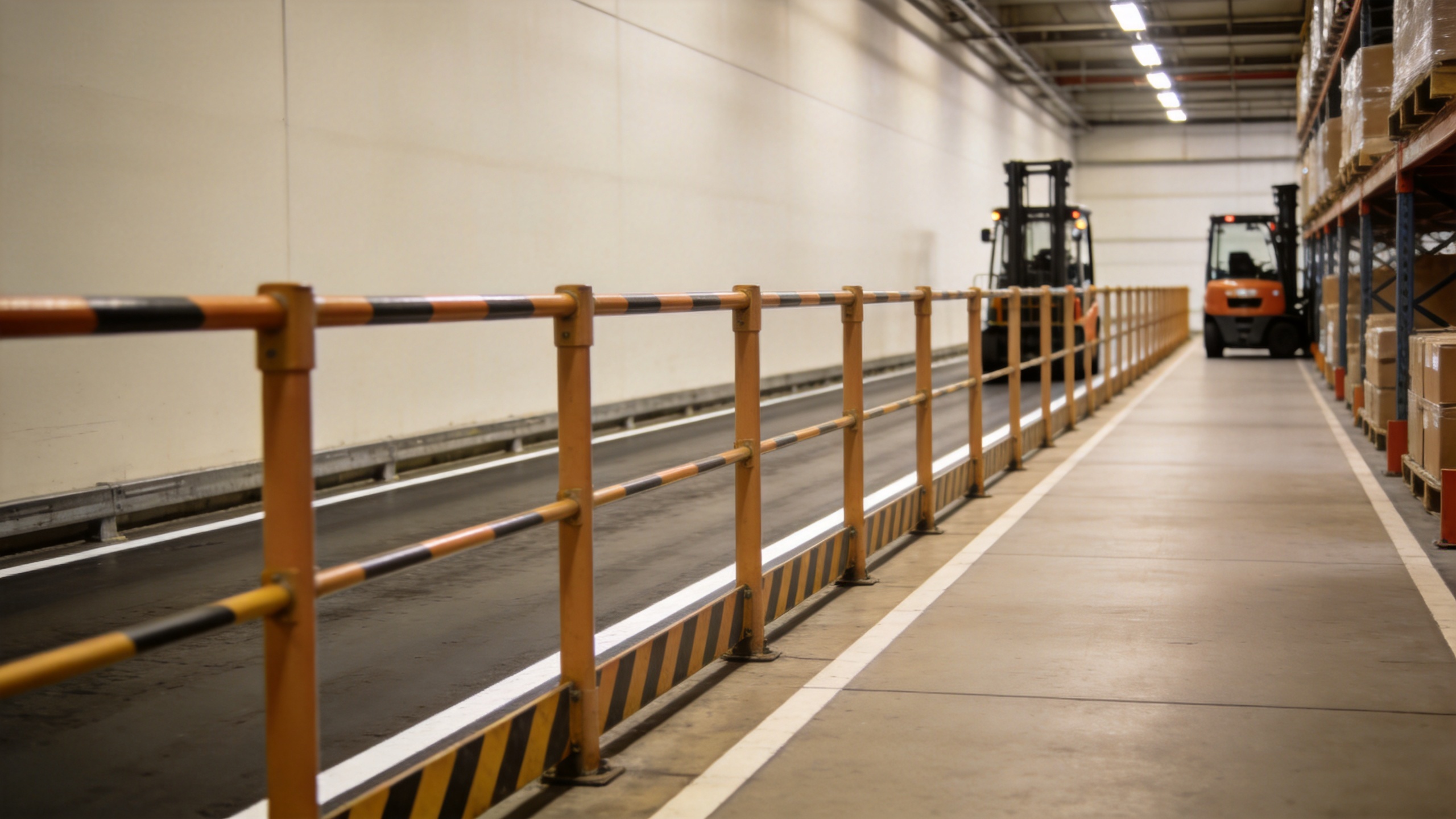
OSHA’s powered-industrial-truck guidance says forklift traffic should be separated from pedestrians where possible. It identifies pedestrian walkways, permanent railings or protective barriers, adequate walking space, and floor striping as options. The appropriate mix depends on the site. Put simply, the barrier choice follows the route problem rather than the other way around.
Classify every zone by traffic exposure
Low exposure: define the route and maintain awareness
Low-exposure areas may have infrequent vehicle movement, good sightlines, low operating speeds, and a clear reason for pedestrians to be present. In these areas, markings, signs, mirrors, procedure controls, and a modest physical boundary may be part of the solution. Do not assume that painted lines alone remain adequate when storage, staffing, or shift patterns change. Check that the marked route remains unobstructed and understandable in daily use.
Medium exposure: prevent routine encroachment
Medium exposure often appears at pedestrian walkways beside active travel lanes, around workstations near material movement, or at rack ends that face a turning route. Here, warehouse safety barriers can establish a more reliable boundary than markings alone. Review clearance on both sides, the possibility of snagging or trapping, emergency egress, cleaning access, and whether the arrangement moves pedestrians toward a safer crossing point.
Rather than evaluating one rail or bollard alone, map how it works with markings, gates, crossing controls, and pedestrian routes. A boundary that blocks a shortcut but encourages an unsafe detour has not solved the full route problem.
High exposure: control the likely impact path
High-exposure locations include blind corners, loading and dispatch areas, reversing zones, constrained intersections, doorways, rack ends, and equipment adjacent to frequent forklift travel. These locations require a more detailed review of likely approach direction, available stopping distance, turning sweep, mounting conditions, and the protected object or people behind the barrier. Select a configuration only after confirming what product evidence applies to the intended installation; a generalized performance statement is not a site-specific design conclusion.
OSHA also notes that permanent aisles and passageways used by mechanical handling equipment must be kept free of obstructions and appropriately marked under 29 CFR 1910.176(a). Barrier placement should support that requirement, not unintentionally narrow or clutter the route.
Match the barrier approach to the exposure
There is no universally suitable barrier. The appropriate option depends on the interaction being controlled, the available space, and the evidence available for that configuration. Use these questions to guide warehouse safety barrier selection:
- Pedestrian separation: Does the layout need a continuous, visible boundary that guides people away from a vehicle route while maintaining access to crossings and exits?
- Rack-end or corner protection: Is the primary exposure a turning vehicle, a narrow aisle, a blind approach, or an asset that projects into the route?
- Door and entry protection: Must the arrangement allow frequent opening, deliveries, emergency use, or controlled pedestrian access?
- Workstation separation: Can the boundary protect people at a fixed task without reducing ergonomic access, maintenance access, or material flow?
- Flexible versus rigid approaches: Which behavior, mounting context, inspection needs, and supplier documentation are relevant to the expected contact scenario? Compare criteria, not marketing labels.
HSE guidance likewise emphasizes separating pedestrians and vehicles where possible, adequate clearance, changing route use at regular times, and avoiding fixtures that create trapping hazards. These principles make a useful check against a barrier layout that looks orderly but does not fit how the warehouse works.
Check clearance, visibility, and access before finalizing
Warehouse collision prevention can fail when a correctly intended barrier creates a new operational constraint. Walk the proposed layout with the people who drive, pick, replenish, clean, maintain, and supervise the zone. Confirm vehicle turning space, load clearance, pedestrian passing space, door swing, access to controls, inspection points, and emergency routes. In planning discussions, this is often the point where access constraints become clearer.
At crossings and blind locations, barriers should support—not replace—visibility, speed control, communication, and operating rules. OSHA advises operators to slow down, stop, and sound the horn at intersections, corners, and obstructed views; it also recommends spotters where blind spots require them. A physical boundary can reduce exposure, but it should be considered alongside these other controls.
Build a specification brief instead of requesting a generic barrier
A concise brief improves both internal review and supplier discussion. Include a scaled route sketch, photos from vehicle and pedestrian viewpoints, vehicle types, traffic frequency by shift, travel direction, turning points, loads, surface and mounting information, required clearances, access needs, and the asset or people being protected. Add the reason the zone was prioritized: a recurring conflict, a near miss if documented, a layout change, or a risk assessment finding.
For every proposed area, state what must remain possible after installation. Examples include pallet movement, door use, maintenance access, cleaning, emergency escape, and future layout changes. The purchase price is only one input; teams may also review installation sequencing, inspection needs, repair options, and disruption to operations.
Review the layout after installation and after change
Warehouse safety barriers are not a “set and forget” control. Inspect their condition, mounting, visibility, and relationship to the current route. Revisit the assessment after a traffic change, new equipment, altered storage, revised picking patterns, an incident, or a near miss. A barrier can support separation, but it should be considered alongside signage, training, housekeeping, and supervisor observation.
The strongest warehouse safety barrier selection process turns a broad safety concern into a defensible decision: map the route, classify the exposure, check practical constraints, select by application, and verify the completed layout in use. That approach gives EHS, operations, engineering, and procurement a shared basis for deciding what belongs in each zone.
 Hot News