 EN


OEM Industrial Safety Barriers: A Guide for Distributors and Project Buyers
For distributors and project buyers, OEM industrial safety barriers are not a catalog item to choose by appearance alone. The useful starting point is the traffic route: where mobile equipment travels, where people walk, where they cross, and what must remain accessible. From a warehouse-buyer perspective, the goal is not to promise that a barrier eliminates risk. It is to build a clear specification and evidence trail so the proposed control fits the operating area.
That route-first approach matters because factories, warehouses, and loading areas change. A layout that works on one shift can become constrained by temporary storage, a revised picking pattern, or a different vehicle approach. When assessing OEM industrial safety barriers, review actual movement at more than one operating period before fixing a configuration.
What “OEM” should mean in an industrial barrier purchase
In this context, OEM industrial safety barriers usually refers to a supply arrangement in which a manufacturer can provide a defined barrier solution under agreed product, configuration, documentation, and commercial requirements. For a distributor, that may include consistent naming, packaging, specification support, and a repeatable quote process. For a project buyer, it may include the ability to translate a site brief into a configuration discussion.
It should not be treated as shorthand for every claim a buyer hopes to make. Before presenting OEM industrial safety barriers to an end user, separate confirmed product information from information that still needs verification. Ask which drawings, test information, material documentation, installation instructions, maintenance guidance, and application limits are actually available for the proposed configuration.
Start with the operating area, not the product family
A polished barrier line can look suitable before the site conditions have been understood. The better question is whether OEM industrial safety barriers match the route problem. Map vehicle paths, pedestrian paths, reversing areas, doors, rack ends, work cells, crossing points, and escape or service access. Note whether traffic volumes change by shift and whether temporary goods narrow a lane.
General workplace-transport guidance supports this discipline. OSHA notes that forklift traffic should be separated from pedestrians where possible and identifies walkways, permanent railings or other protective barriers, and markings as possible measures. HSE guidance similarly addresses barriers, marked routes, crossings, visibility, and changing traffic volumes. These references provide planning context; they do not certify a particular product or replace a site-specific assessment.
Specify the protective objective before comparing options
Buyers often compare OEM industrial safety barriers as if one headline feature settles the choice. It does not. Write down the intended objective first:
- guide pedestrians away from a vehicle route;
- define a protected walkway or work zone;
- reduce exposure at a rack end, corner, doorway, or loading area;
- separate people protection from asset protection; or
- support a changing layout without losing clarity about access.
Then document what can affect that objective: likely vehicle approach direction, route geometry, floor and mounting conditions, clearance, access needs, and the information needed to verify suitability. This is where OEM industrial safety barriers should be compared on application fit rather than on a generic “stronger is better” assumption.
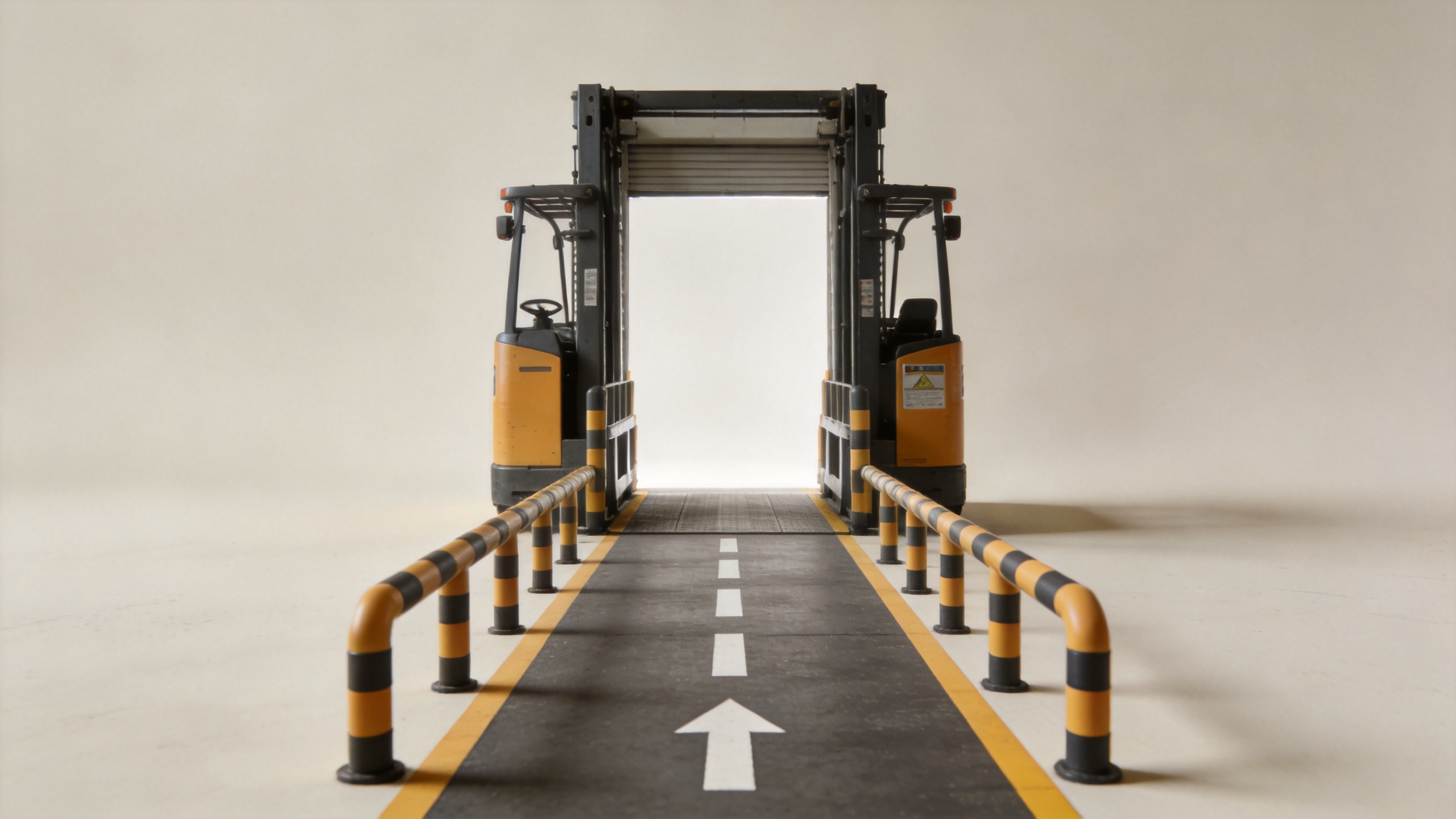
How to assess a flexible safety barrier manufacturer
When evaluating a flexible safety barrier manufacturer, focus on the manufacturer’s ability to support an application-led discussion. A flexible option may be relevant where a buyer is exploring route separation, constrained aisles, or operational changes, but suitability still depends on the full configuration and the verified evidence for it.
A practical review asks whether the flexible safety barrier manufacturer can explain the system boundaries, provide current documentation, identify installation assumptions, and clarify which details require engineering or local safety review. Do not turn a general material description into a performance guarantee. Instead, request evidence that is specific to the barrier, mounting context, and intended use.
What distributors should request from an industrial safety barrier supplier
An industrial safety barrier supplier can make the sales process more reliable by helping a distributor assemble a consistent specification brief. At minimum, record the site zone, route sketch or dimensions, traffic type, likely approach paths, pedestrian movements, required openings, floor conditions, and installation constraints. Add any customer requirements for drawings, labeling, packaging, lead-time planning, or private-label presentation.
For repeatable quotations, ask the industrial safety barrier supplier to identify the exact configuration covered by each document. This prevents a common handoff problem: a brochure may describe a product family while the project needs proof for a particular height, length, post spacing, connection, or mounting arrangement. Evidence before assertion is especially important when OEM industrial safety barriers will be represented through a distributor channel.
Build an RFQ that supports a useful OEM conversation
A strong RFQ helps an industrial safety barrier supplier respond with relevant questions instead of generic catalog pages. Include the following:
- Zone and purpose: What interaction or exposure is being addressed?
- Route information: Where do vehicles and pedestrians travel, turn, reverse, or cross?
- Access requirements: What must remain open for operators, cleaning, maintenance, emergency use, or material flow?
- Installation context: What is known about the floor, fixings, obstructions, and work schedule?
- Evidence request: Which configuration-specific documents are needed before approval?
- Commercial scope: Are branding, packaging, stocking, phased delivery, or distributor support required?
This checklist makes discussions about OEM industrial safety barriers faster without pretending that every site has the same answer. It also gives internal EHS, operations, engineering, procurement, and sales teams a shared language for reviewing an offer.
Compare the full operating picture, not only the purchase price
The lowest initial price can be difficult to compare if the proposed options do not address the same route, access, documentation, or installation needs. For OEM industrial safety barriers, compare what is included in the scope, what assumptions are stated, what evidence applies to the actual configuration, and what support is available if the layout changes. A barrier system is only one part of a wider control approach that can also involve route management, markings, procedures, training, and review.
A final operational check is useful: a visible barrier does not automatically mean everyone understands the route. Confirm how people will be directed at crossings, how temporary conditions will be handled, and who will revisit the layout after a change. That measured review is more useful than making broad claims about OEM industrial safety barriers.
Final checklist for project buyers and distributors
Before selecting OEM industrial safety barriers, confirm the route, protective objective, configuration inputs, access constraints, evidence requirements, and handoff responsibilities. Before approving OEM industrial safety barriers, verify that the documentation describes the actual proposed arrangement, not merely a similar product family. Finally, plan a post-installation review with the people who use the area.
For distributors, the opportunity is to turn OEM industrial safety barriers into a disciplined specification process. For project buyers, the value is a clearer basis for comparing options and asking the next question before a product decision is locked in.
 Hot News

