EN


Flexible Safety Barriers vs. Steel Barriers: A Total Cost Comparison
For a warehouse or production site, the choice between flexible vs steel safety barriers is rarely just a materials decision. It is a decision about what happens after the purchase order: how the system fits the route, what an impact can disrupt, who repairs it, and how easily the layout can change. A lower initial price can be useful, but it is not the same as a lower total cost.
From a buyer’s viewpoint, compare the two options over the operating life of the protected area. That means putting installation, repairs, traffic interruption, inspections, and future modifications beside the purchase price. Neither steel nor polymer safety barriers are automatically the better answer; exposure, mounting conditions, traffic behavior, and the need for operational continuity determine which costs matter most.
Start With the Safety Problem, Not the Catalog
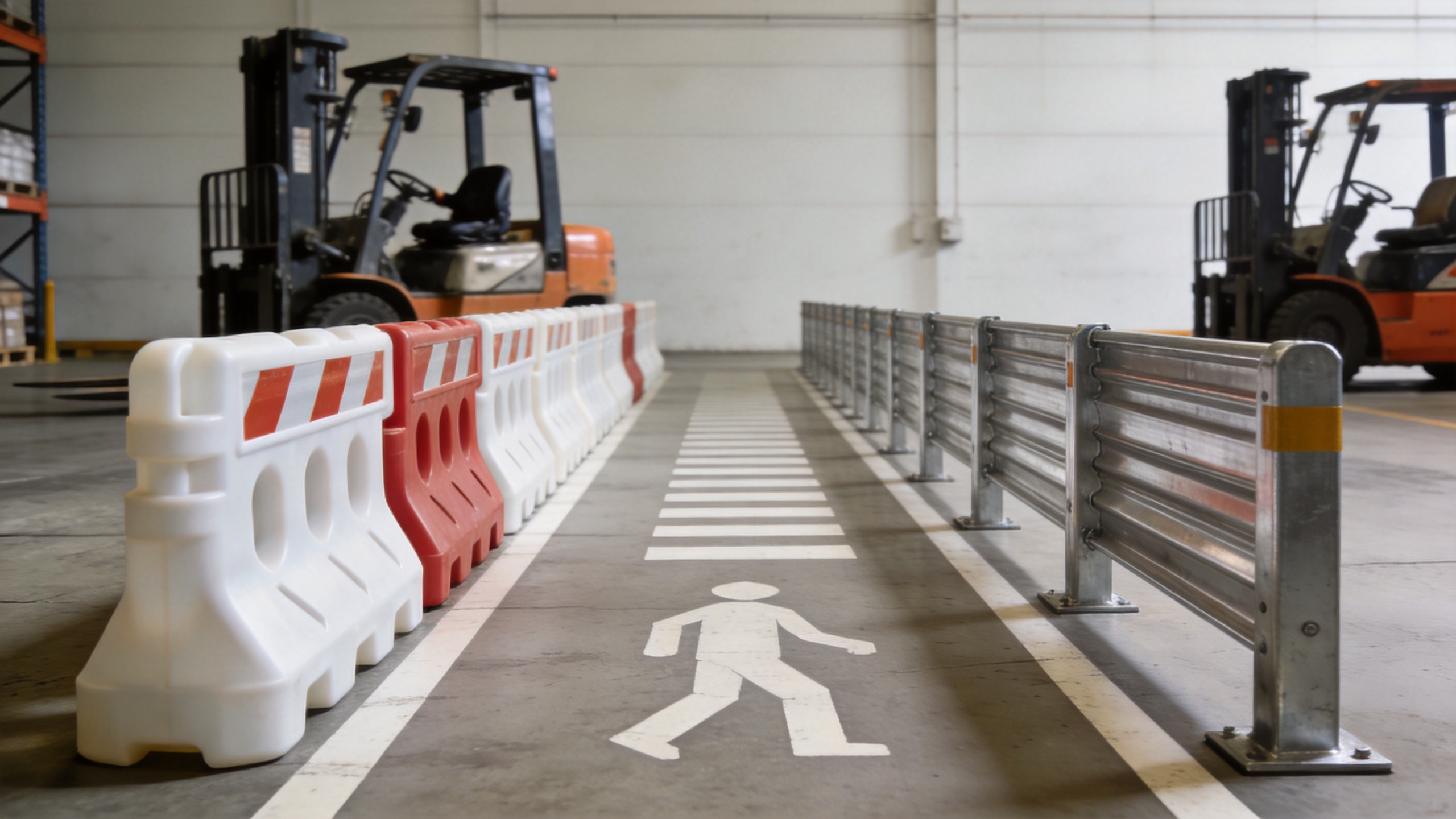
Before comparing a flexible crash barrier with steel, define the route conflict. Is the barrier separating pedestrians from forklifts, protecting a rack end, guarding a doorway, or keeping vehicles away from machinery? OSHA advises separating forklift traffic from pedestrians where possible, including with permanent railings or other protective barriers. HSE similarly emphasizes separate vehicle and pedestrian routes where practical, adequate clearance, and prevention of trapping hazards. Those principles make barrier layout a part of a wider traffic-control plan, not a stand-alone fix.
A site review should document vehicle type, travel direction, likely strike points, available floor space, door and emergency access, floor condition, and whether pallets or workstations regularly change the route. This is where an attractive unit price can become misleading: a low-cost line of steel may be unsuitable if the finished layout creates a clearance problem, while a flexible system may be unnecessary where traffic is slow, predictable, and well separated.
The Cost Categories That Belong in the Comparison
A useful flexible vs steel safety barriers comparison uses the same cost categories for both systems. Ask suppliers to separate quoted numbers and assumptions so the team can compare like for like.
| Cost category | Questions to ask for steel barriers | Questions to ask for polymer safety barriers |
|---|---|---|
| Initial supply and installation | What steel sections, anchors, coatings, labor, and floor preparation are included? | What posts, rails, fixings, modular components, labor, and floor preparation are included? |
| Impact response | After a foreseeable strike, which parts, anchors, or adjacent floor areas need inspection or repair? | After a foreseeable strike, what inspection, reset, or component-replacement procedure applies? |
| Operational interruption | Would repair isolate an aisle, require hot work, or interrupt loading and pedestrian access? | Would inspection or replacement restrict the route, and for how long under the supplier’s documented process? |
| Inspection and upkeep | Who checks deformation, corrosion, paint damage, loose anchors, and slab condition? | Who checks visible damage, fixings, posts, and any manufacturer-specified components? |
| Future change | Can the configuration be moved or extended without extensive removal and making-good? | Can modular sections be reconfigured, and what new components or labor are required? |
The key is to obtain documented answers for the exact configuration and anticipated impact conditions. Avoid inserting generic savings percentages into an approval paper unless the figures come from your own incident records or a supplier’s applicable, verified evidence.
Where Steel Can Be the Sensible Cost Choice
Steel barriers can be a practical option where the risk assessment calls for a rigid physical boundary and the traffic pattern is stable. A simple, appropriately specified steel installation may have a familiar procurement path, can suit locations with limited expected contact, and may be straightforward to integrate into an existing fixed layout.
However, the purchase price should not be treated as the whole business case. After a strike, review the barrier, its fixings, and the surrounding slab rather than assuming a visible dent is cosmetic. The cost event may include isolating the area, arranging labor, sourcing replacement pieces, restoring coatings, and checking whether the route can reopen safely. Where impacts are infrequent and access is easy, those downstream items may remain modest. Where contact is recurring or an aisle is business-critical, they may become a larger part of the lifecycle cost.
Where Flexible Polymer Barriers May Change the Cost Profile
Flexible polymer safety barriers are typically considered when a site wants a barrier system that can be specified around vehicle-pedestrian separation, rack ends, corners, or equipment zones while maintaining an operationally clear layout. The relevant question is not whether a flexible crash barrier is “maintenance free.” It is what the supplier documents for the specific system after the anticipated impact, and whether that process reduces the frequency, scope, or disruption of repair work compared with the alternative.
For a busy route, a buyer may value a system that supports faster inspection and a more controlled recovery process after minor contacts. That potential value must be tested against the higher initial spend that some polymer safety barriers can carry, the site’s mounting surface, the actual vehicle and approach conditions, and the cost of spares. Ask for impact-test scope, installation instructions, inspection requirements, warranty terms, and a written list of components expected to be replaced after a strike.
Turn Total Cost Into a Site-Specific Model
Use a simple annualized model instead of a universal claim:
Total cost over the review period = initial installed cost + planned inspection cost + expected impact-response cost + expected downtime cost + modification cost − residual value, if applicable.
For expected impact-response cost, use your own near-miss and damage history where possible. Estimate the number of likely contacts per year, then identify the documented labor, parts, access controls, and route closure required for each response. For downtime, involve operations rather than guessing: an hour of restricted access at a low-activity storage edge does not carry the same consequence as an hour at a dispatch lane or a production entrance.
Build at least three scenarios: low contact, typical contact, and elevated contact. Then compare the flexible vs steel safety barriers options across the same period and assumptions. This keeps the discussion honest when the final decision depends on risk tolerance rather than a single price point.
This approach prevents a flexible vs steel safety barriers comparison from becoming a spreadsheet exercise detached from operations. A compact model that names its assumptions is more useful than a projected saving that cannot be validated later.
Five Questions for Procurement, EHS, and Operations
- What impact exposure is being designed for? Confirm vehicle type, speed controls, direction of travel, load behavior, and the location of pedestrians.
- What is the recovery procedure after a strike? Request a configuration-specific procedure for inspection, isolation, repair, and return to service.
- What happens to the floor and fixings? Review substrate condition, anchor requirements, and who owns any remedial work.
- What must remain accessible? Check emergency egress, doors, controls, maintenance points, and normal turning clearance before finalizing the layout.
- How likely is the layout to change? Consider seasonal storage, added equipment, altered pallet flow, and phased expansion before treating a fixed configuration as permanent.
Choose the Barrier That Fits the Operating Boundary
The most reliable conclusion in a flexible vs steel safety barriers evaluation is usually conditional. Steel can be cost-effective where the layout is stable, impacts are limited, and a rigid boundary is appropriate. Flexible polymer safety barriers can deserve closer consideration where route exposure, repeat contact, repair disruption, or future reconfiguration make lifecycle costs more important than the initial purchase price.
Bring EHS, maintenance, operations, and procurement into the same review. Compare supplier documentation for the exact barrier configuration, verify the installation conditions, and model the cost of realistic impact events instead of relying on a headline price. A barrier is only one layer of control; marked routes, speed management, training, visibility, and disciplined housekeeping still determine whether the protected area works in daily use.
Frequently Asked Questions
Are flexible barriers necessarily cheaper over time than steel barriers?
No. A flexible system may change the repair and downtime profile, but the total result depends on the installed cost, impact frequency, the supplier’s documented recovery procedure, site conditions, and the cost of operational interruption.
Can a steel barrier still be the right choice?
Yes. Steel may be suitable for a stable, appropriately assessed location where the required rigidity, installation conditions, and expected impact exposure support that choice. Compare the full recovery process after an impact, not only the initial quotation.
What evidence should a buyer request?
Request configuration-specific drawings, installation and inspection instructions, applicable test information and scope, fixing requirements, warranty terms, replacement guidance, and a clear statement of assumptions. Confirm that the evidence applies to the intended vehicle, route, and mounting conditions.
 Hot News