EN


Automotive Factory Safety Barriers for Assembly and Manufacturing Areas
Automotive factories are built around movement: components arrive at receiving bays, carts feed assembly cells, forklifts replenish line-side racks, and maintenance teams move between machines. That movement creates intersections between people, vehicles, equipment, and production assets. Automotive factory safety barriers can support a clearer separation plan when they are chosen from the actual traffic pattern instead of from a catalog image.
From an EHS perspective, a barrier is one layer in a broader traffic-management system. It can help define a route or protect an exposed asset, but it does not replace speed controls, operator training, pedestrian rules, signage, or a machine-specific guarding review. The practical question is not “Which barrier looks strongest?” It is “Where is the exposure, who uses the area, and what must remain accessible during a normal shift?”
Start with the automotive factory risk map
Before selecting automotive factory safety barriers, walk the production area and record where movement converges. Useful maps show vehicle routes, pedestrian crossings, emergency egress, manual workstations, charging points, rack ends, doors, and service panels. They should also show what changes during peak material delivery, model changeovers, or maintenance windows.
A common planning miss is checking forklift turning clearance only after a proposed barrier location is fixed. In automotive assembly, a route that seems open when a line is idle may become tight when pallets, stillages, tugger trains, or returnable containers enter the area. The map should therefore describe the likely approach direction, turning movement, visibility, and the places where loads extend beyond the vehicle footprint.
Separate three different protection questions
- People separation: Where do pedestrians need a clearly legible route away from powered industrial trucks or tuggers?
- Asset protection: Which rack ends, machine corners, electrical cabinets, doors, and line-side structures are exposed to an impact path?
- Machine guarding: Which hazards arise at a machine point of operation and require a dedicated machine-guarding assessment rather than a traffic barrier?
Keeping these questions separate prevents a physical boundary from being treated as a universal answer. OSHA forklift guidance, for example, encourages separating lift-truck traffic from pedestrians where possible and lists walkways, permanent railings or other protective barriers, marking, mirrors, signs, and speed controls as complementary measures. That is a useful planning principle, not a substitute for a site-specific safety review.
Where barriers often support safer assembly operations
1. Line-side material replenishment
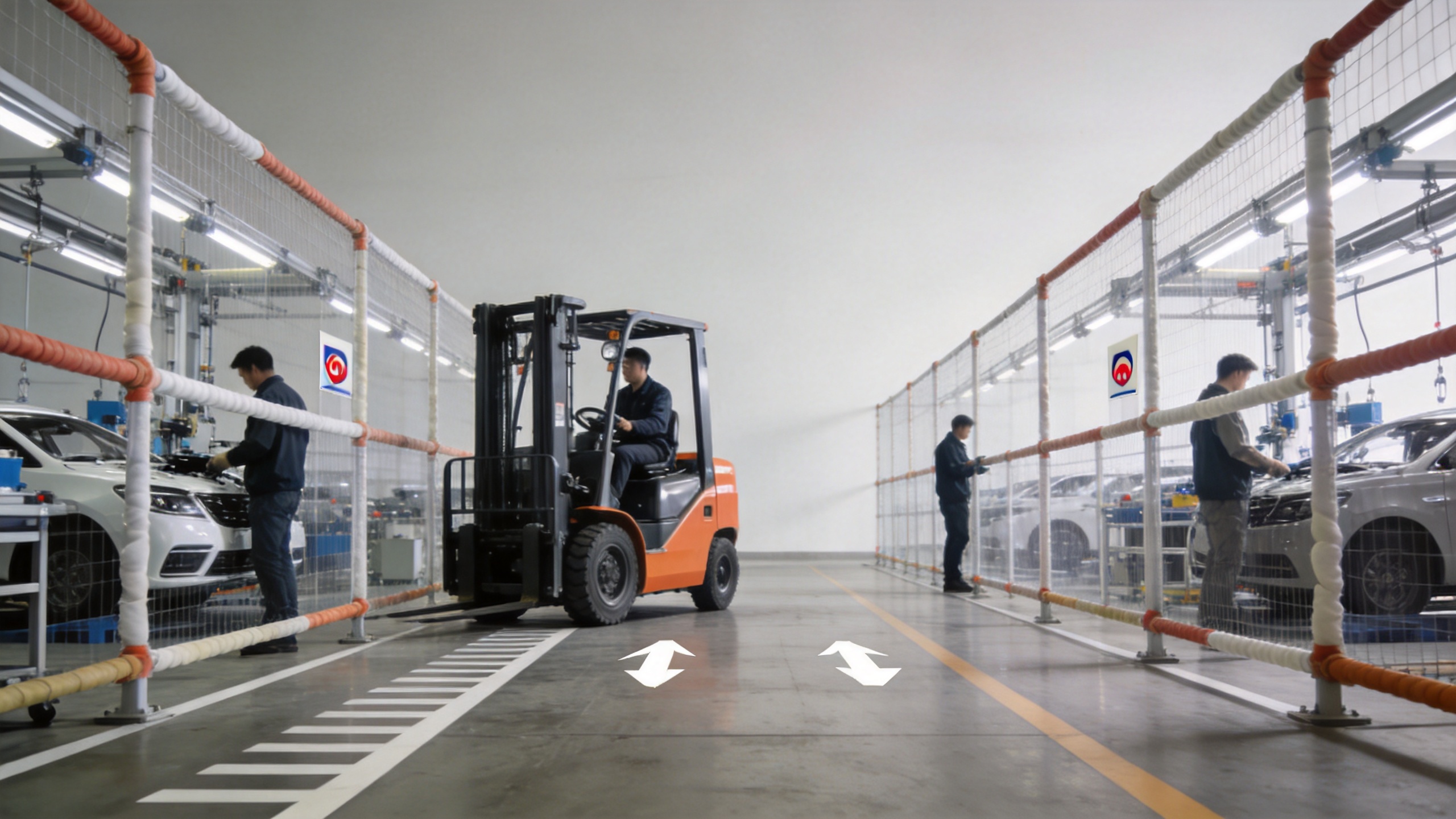
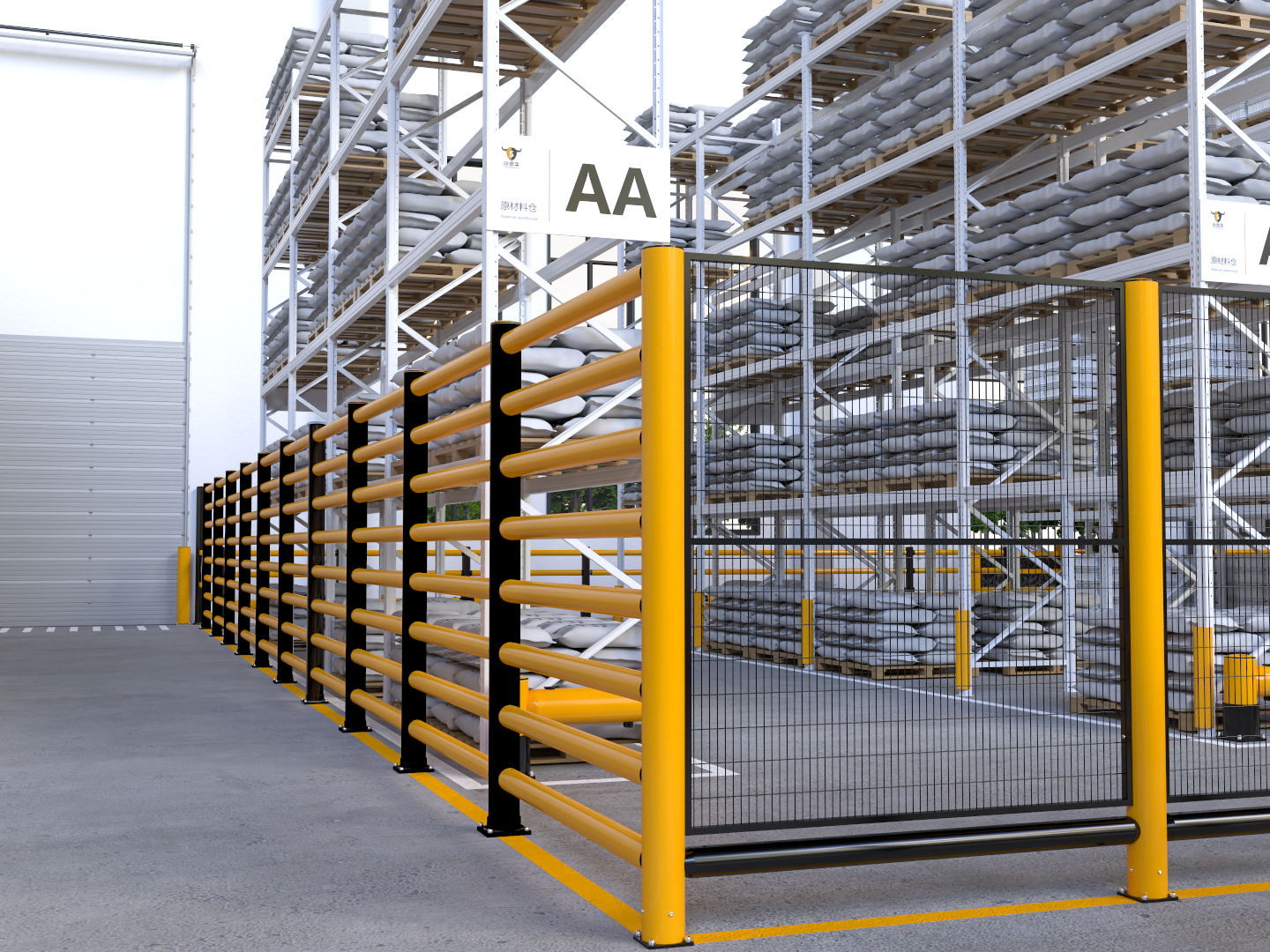
Assembly lines need regular deliveries of components, packaging, and returnable containers. Where a forklift or tugger route passes close to an operator station, industrial guardrails can help make the intended boundary visible and discourage casual shortcuts into a vehicle lane. The installation still needs enough space for ergonomic work, replenishment activity, evacuation, and any planned access to the workstation.
Ask a simple question: can a worker still understand the intended route when pallets temporarily occupy the area? If the answer is no, improve the route design first. Automotive factory safety barriers are more effective when markings, signs, and behavior rules point in the same direction.
2. Intersections, blind corners, and cross-aisles
Intersections deserve separate treatment because they combine turning, restricted sight lines, and mixed traffic. Factory collision protection may include a defined pedestrian crossing, a barrier run that channels movement to the crossing point, mirrors where appropriate, and a clear rule for vehicle speed and warning. A barrier should not conceal a person or narrow the turning envelope beyond what the vehicle and load require.
Look for whether operators can see the route boundary before entering the area. If visibility depends on a temporary opening, stacked containers, or a door position, document that condition and revisit the layout rather than assuming the route is stable.
3. Robotic cells, conveyors, and machinery edges
Traffic barriers can protect the outside of a robotic cell, conveyor support, or machine enclosure from unintended vehicle contact. They do not decide whether the machine itself is adequately guarded. OSHA’s general machine-guarding requirement addresses points of operation that expose employees to injury; that is a different hazard from a forklift striking the outer edge of a production asset. Treat both reviews as necessary when both hazards exist.
For an automotive plant, this distinction matters around automated stations. A vehicle-facing barrier may guide traffic away from an enclosure, while the equipment owner and qualified safety personnel review access gates, interlocks, emergency stops, and required clearances. Do not allow factory collision protection to create a new obstruction to maintenance or emergency access.
4. Rack ends, charging areas, and building interfaces
Line-side racks, battery-charging locations, support columns, dock doors, and electrical cabinets are often concentrated near material movement. These locations can benefit from a coordinated plan for automotive factory safety barriers, posts, rails, markings, and access controls. Corners and exposed ends deserve additional attention because turning traffic may concentrate there.
More material is not automatically more protection if the likely impact path is not addressed. Review the approach angle, available stopping space, floor condition, mounting surface, and what sits behind the proposed barrier. A neat-looking installation is useful, yet the likely path of a load or vehicle should be checked before appearance drives the decision.
How to choose a barrier configuration without over-specifying
The suitable configuration depends on the zone, not on a single headline feature. Use the following questions to compare automotive factory safety barriers with discipline:
- What moves through the area? Record vehicle type, load shape, direction of travel, turning frequency, and peak activity rather than assuming one route represents every shift.
- What is being protected? Identify whether the primary aim is pedestrian separation, asset protection, route guidance, or a combination of these.
- What clearance must remain? Test normal production, changeover, maintenance, cleaning, emergency egress, and manual handling—not only the empty floor plan.
- What is the mounting context? Confirm the substrate, fixing conditions, drainage, floor joints, and any limits that require engineering or installation review.
- What evidence is relevant? Before treating an impact-performance statement as a decision point, confirm which test conditions and installation assumptions apply to the proposed arrangement.
This approach also helps when comparing flexible and rigid options. A flexible barrier may be considered where the operating context, interface, and verified application evidence support it; a rigid rail or post may be considered in another context. Neither label alone establishes suitability. The aim is to reduce exposure in the route, not to imply zero risk.
Plan for changeovers and maintenance from the beginning
Automotive factories change. A new model program, an altered kitting process, additional automation, or a revised packaging flow can change where vehicles turn and where people cross. If a production line may be reconfigured, include adjustment and review needs in the first plan. A highly fixed layout can simplify current separation, while an adaptable one may help when a future route change is plausible.
Inspection should also be part of the operating plan. Assign who checks for loose fixings, visible deformation, damaged markings, blocked routes, or changes in line-side storage. Record assumptions about vehicle type and traffic direction so later reviewers can test whether they remain true. Early input from people who work in the area often reveals access or timing details that a drawing misses.
A practical review checklist for automotive assembly areas
- Map forklift, tugger, cart, pedestrian, and maintenance movements across more than one operating period.
- Identify crossings, blind corners, machine edges, rack ends, doors, and electrical or charging interfaces.
- Confirm which controls are for people separation, which are for asset protection, and which require machine-guarding review.
- Check turning space, visibility, emergency egress, cleaning, and access before fixing barrier locations.
- Use factory collision protection together with markings, signs, operating rules, training, and appropriate visual controls.
- Review relevant product or test evidence against the actual mounting and application conditions before specification.
- Revisit the plan after a material-flow, layout, vehicle, or production change.
Build the barrier plan around the route, not the catalog
Well-planned automotive factory safety barriers help teams make route boundaries and asset-protection priorities easier to understand. Their value comes from how they support a wider safety system: a current traffic map, practical visibility, accessible workstations, clear operating rules, and periodic review. Industrial guardrails may be part of that system, but the final configuration should follow verified site conditions.
Use this article as a starting framework, then confirm dimensions, traffic behavior, mounting conditions, and applicable evidence before finalizing a configuration. When factory collision protection is evaluated this way, the discussion stays focused on the exposure that needs to be controlled rather than on an unsupported product claim.
 Hot News